


Glucagon ELISA Kit Wako (Sandwich method)
- for Diabetes Research
- Manufacturer :
- FUJIFILM Wako Pure Chemical Corporation
- Storage Condition :
- Keep at 2-10 degrees C.
- GHS :
-


-
 Close
- Structural Formula
- Label
- Packing
- SDS
|
Comparison
|
Product Number
|
Package Size
|
Price
|
Availability
|
Certificate of Analysis
|
Purchase |
|---|---|---|---|---|---|---|
|
|
|
96Tests
|
|
In stock in Japan |
※Check availability in the US with the distributor.
Document
Kit component
For 96 tests
| Antibody-coated 96-well Plate | 96 wells (8×12) / 1 plate |
|---|---|
| Glucagon Standard | 0.287 pmol / 1 vial |
| HRP-conjugated Anti Glucagon Antibody Solution | 12 mL / 1 bottle |
| TMB Solution | 12 mL / 1 bottle |
| Stop Solution | 12 mL / 1 bottle |
| Buffer | 12 mL / 1 bottle |
| Wash Solution (20×) | 50 mL / 1 bottle |
| Plate Seal | 2 sheets |
Product Overview
Glucagon is a peptide hormone comprising 29 amino acids and secreted from α cells in the islets of Langerhans. Physiologically, it acts on liver to degrade glycogen to glucose and increase blood glucose levels. Together with insulin, it plays an important role in maintaining blood glucose level.
This kit is a sandwich ELISA kit for the quantitative measurement of glucagon in samples, using monoclonal antibodies that recognize the N- and C-terminus of glucagon, respectively. The assay with this kit shows low cross-reactivity, if any, to glucagon-related peptides such as glicentin, oxyntomodulin, GLP-1 or GLP-2.
Kit Performance
| Analysis sample | Human Serum/Plasma(EDTA) Mouse Serum/Plasma(EDTA) Rat Serum/Plasma(EDTA) Culture medium |
|---|---|
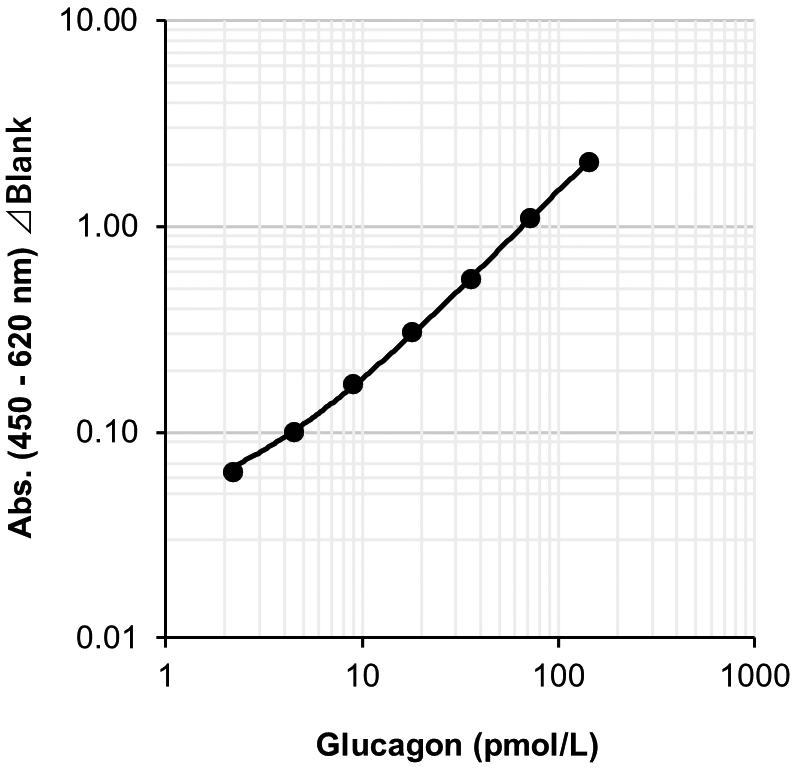
| Calibration curve range | 2.2-143.6 pmol/L (7.8-500 pg/mL) |
| Sample volume | 10 μL |
| Measurement duration | Approx. 20 hours |
| Detection method | Colorimetric (Primary: 450 nm / Reference: 620 nm) |
Example of Calibration Curve Range
Precision
Repeatability (within run precision)
Repeatability was conducted by measuring eight fold assays of serum/plasma (EDTA) samples from human, mouse and rat with this product.
[Result]
The CV (%) of serum samples from human, mouse and rat was 1.8-3.5%, indicating good repeatability.
The CV (%) of plasma (EDTA) samples from human, mouse and rat was 2.1-4.6%, indicating good repeatability.
Reproducibility (between run precision)
Reproducibility was conducted by measuring serum/plasma (EDTA) samples from human, mouse and rat at four concentrations each for five days with this product.
[Result]
The CV (%) of serum samples from human, mouse and rat was 3.5-9.1%, indicating good reproducibility.
The CV (%) of plasma (EDTA) samples from human, mouse and rat was 3.4-7.1%, indicating good reproducibility.
Data
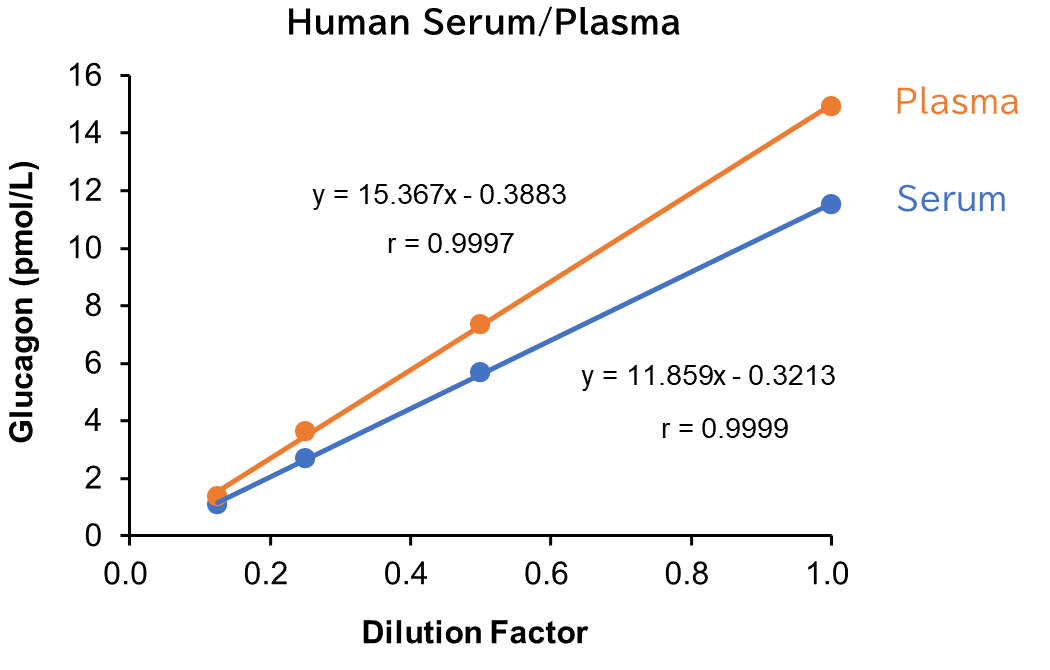
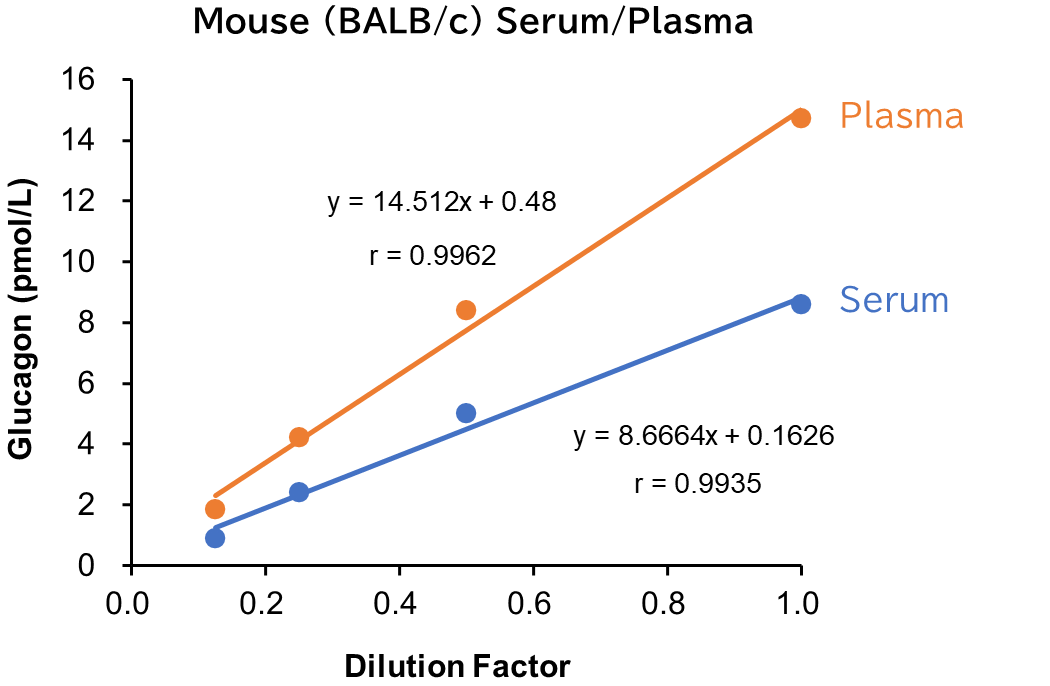
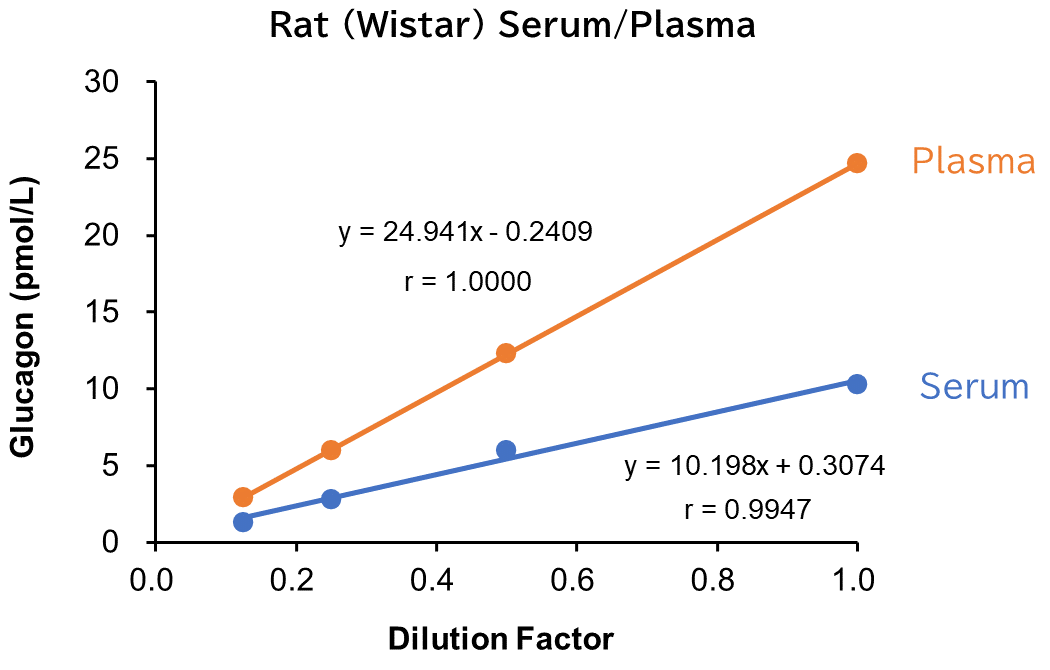
Dilution Linearity Test
Serum and plasma (EDTA) samples from human, mouse and rat were serially diluted twofold with the buffer in this kit and measured in duplicate to assess linearity.
[Result]
All measurement results showed good linearity within the measurement range.
Spike and Recovery Test
Standard solutions at three concentrations were added to serum/plasma (EDTA) from human, mouse and rat. Next, spike recovery tests were conducted, with each measurement performed in duplicate.
Human serum
| Spiked amount (pmol/L) |
Measurement value (pmol/L) |
Recovery volume (pmol/L) |
Recovery rate (%) |
|
|---|---|---|---|---|
| A | 0.0 | 10.80 | - | - |
| 2.9 | 14.05 | 13.67 | 103 | |
| 14.4 | 25.67 | 25.16 | 102 | |
| 57.4 | 68.39 | 68.22 | 100 | |
| Average | 102 | |||
| B | 0.0 | 4.31 | - | - |
| 2.9 | 6.89 | 7.18 | 95.9 | |
| 14.4 | 18.62 | 18.67 | 99.8 | |
| 57.4 | 57.71 | 61.73 | 93.5 | |
| Average | 96.4 | |||
Human plasma
| Spiked amount (pmol/L) |
Measurement value (pmol/L) |
Recovery volume (pmol/L) |
Recovery rate (%) |
|
|---|---|---|---|---|
| A | 0.0 | 12.51 | - | - |
| 2.9 | 16.04 | 15.38 | 104 | |
| 14.4 | 26.89 | 26.87 | 100 | |
| 57.4 | 68.83 | 69.93 | 98.4 | |
| Average | 101 | |||
| B | 0.0 | 10.97 | - | - |
| 2.9 | 14.21 | 13.84 | 103 | |
| 14.4 | 23.95 | 25.33 | 94.6 | |
| 57.4 | 62.38 | 68.39 | 91.2 | |
| Average | 96.1 | |||
Mouse (BALB/c) serum
| Spiked amount (pmol/L) |
Measurement value (pmol/L) |
Recovery volume (pmol/L) |
Recovery rate (%) |
|
|---|---|---|---|---|
| A | 0.0 | 8.11 | - | - |
| 2.9 | 10.92 | 10.98 | 99.4 | |
| 14.4 | 20.48 | 22.47 | 91.2 | |
| 57.4 | 53.75 | 65.53 | 82.0 | |
| Average | 90.9 | |||
| B | 0.0 | 5.60 | - | - |
| 2.9 | 8.17 | 8.47 | 96.4 | |
| 14.4 | 18.10 | 19.96 | 90.7 | |
| 57.4 | 54.54 | 63.02 | 86.5 | |
| Average | 91.2 | |||
Mouse (BALB/c) plasma
| Spiked amount (pmol/L) |
Measurement value (pmol/L) |
Recovery volume (pmol/L) |
Recovery rate (%) |
|
|---|---|---|---|---|
| A | 0.0 | 18.24 | - | - |
| 2.9 | 21.82 | 21.11 | 103 | |
| 14.4 | 31.64 | 32.60 | 97.1 | |
| 57.4 | 65.06 | 75.66 | 86.0 | |
| Average | 95.5 | |||
| B | 0.0 | 6.55 | - | - |
| 2.9 | 9.13 | 9.42 | 96.9 | |
| 14.4 | 18.71 | 20.91 | 89.5 | |
| 57.4 | 54.69 | 63.97 | 85.5 | |
| Average | 90.6 | |||
Rat (Wistar) serum
| Spiked amount (pmol/L) |
Measurement value (pmol/L) |
Recovery volume (pmol/L) |
Recovery rate (%) |
|
|---|---|---|---|---|
| A | 0.0 | 6.46 | - | - |
| 2.9 | 8.86 | 9.33 | 94.9 | |
| 14.4 | 20.08 | 20.82 | 96.5 | |
| 57.4 | 56.71 | 63.88 | 88.8 | |
| Average | 93.4 | |||
| B | 0.0 | 5.46 | - | - |
| 2.9 | 8.12 | 8.33 | 97.5 | |
| 14.4 | 19.57 | 19.82 | 98.8 | |
| 57.4 | 50.75 | 62.88 | 80.7 | |
| Average | 92.3 | |||
Rat (Wistar) plasma
| Spiked amount (pmol/L) |
Measurement value (pmol/L) |
Recovery volume (pmol/L) |
Recovery rate (%) |
|
|---|---|---|---|---|
| A | 0.0 | 18.73 | - | - |
| 2.9 | 22.10 | 21.60 | 102 | |
| 14.4 | 34.36 | 33.09 | 104 | |
| 57.4 | 69.72 | 76.15 | 91.6 | |
| Average | 99 | |||
| B | 0.0 | 13.25 | - | - |
| 2.9 | 16.32 | 16.12 | 101 | |
| 14.4 | 27.61 | 27.61 | 100 | |
| 57.4 | 69.51 | 70.67 | 98.4 | |
| Average | 100 | |||
[Result]
Good recovery rates were confirmed.
Cross-Reactivity with Similar Peptides
Using this product, cross-reactivity was assessed by measuring structurally related peptides at each concentrations.
| Species | Similar peptides | Concentrations (pmol/L) | Measurement value (pmol/L) | Cross-Reactivity (%) |
|---|---|---|---|---|
| Human | Glicentin (1-69) | 100,000 | 680 | 0.68 |
| Glicentin (1-61) | 100,000 | 950 | 0.95 | |
| Oxyntomodulin | 100,000 | 640 | 0.64 | |
| Mini-glucagon | 37,000 | N.D. | - | |
| GLP-1 (7-36) NH2 | 15,200 | N.D. | - | |
| GLP-1 (9-36) NH2 | 16,200 | N.D. | - | |
| GLP-2 | 13,300 | N.D. | - | |
| GIP | 4,000 | N.D. | - | |
| Mouse | Glicentin (1-69) | 100,000 | 970 | 0.97 |
| Oxyntomodulin | 100,000 | 640 | 0.64 | |
| Mini-glucagon | 37,000 | N.D. | - | |
| GLP-1 (7-36) NH2 | 15,200 | N.D. | - | |
| GLP-1 (9-36) NH2 | 16,200 | N.D. | - | |
| GLP-2 | 13,200 | N.D. | - | |
| GIP | 4,000 | N.D. | - | |
| Rat | Glicentin (1-69) | 100,000 | 960 | 0.96 |
| Oxyntomodulin | 100,000 | 640 | 0.64 | |
| Mini-glucagon | 37,000 | N.D. | - | |
| GLP-1 (7-36) NH2 | 15,200 | N.D. | - | |
| GLP-1 (9-36) NH2 | 16,200 | N.D. | - | |
| GLP-2 | 13,000 | N.D. | - | |
| GIP | 4,000 | N.D. | - |
Correlation with products from other competitors
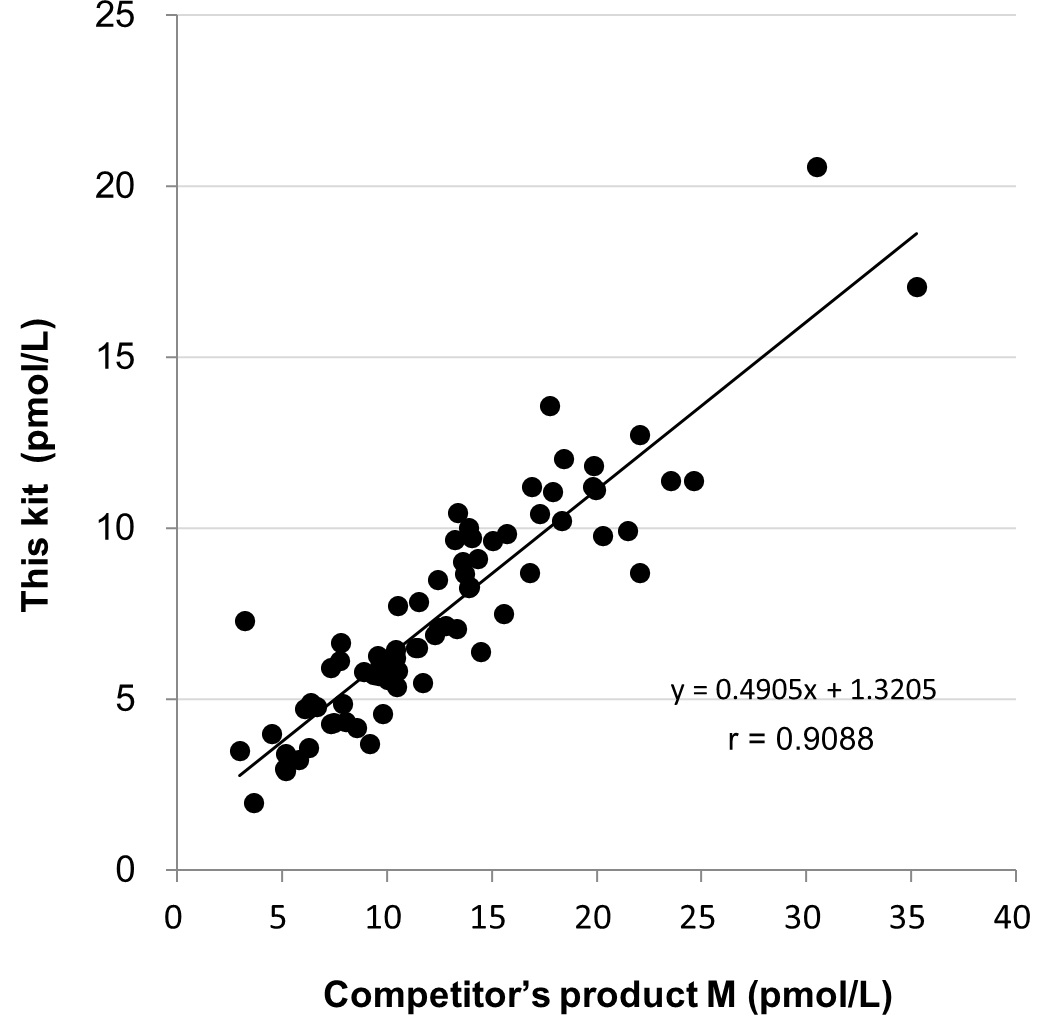
Measurements were conducted on the same samples (n=78) of serum from human using this kit and competitor's product M. The measurement values obtained using both products were then compared.
[Result]
This product showed a high correlation with the competitor’s product M.
FAQ
About sample
- What should I do with handling blood sample?
- For serum sample, coagulate and centrifuge the sample, and use the supernatant for assay. For plasma sample, EDTA-2Na additive blood collection tube is recommended for collection (final concentration : 1 mg/mL blood). To add aprotinin, add it to make final concentration of 500 KIU/mL blood. (For preparation of serum, separate and collect the serum before adding aprotinin.) To add DPP-4 inhibitor, add it to make concentration of 10 µL/mL blood.
If the samples are tested later, they should be divided into test tubes in small amount appropriately and frozen -80℃. Avoid repeated freezing and thawing of samples.
About kit usage
- What instruments, and equipment are required for the assay using this kit?
- Micropiprtte and tip (10-1,000 µL) (8- or 12-channel multichannel pipettes are recommended)
- Microplate reader (equipment that can measure the absorbance up to 3.0 at 450 nm)
- Glass tets tubes
- Microplate washer (continuous dispenser, needle dispenser, and aspirator or vacuum pump are recommended for manual method)
- Graduated cylinder (1,000 mL)
- Distilled water or deionized water
- What are the precautions for the solution preparation or measurement?
- Please read the instruction manual carefully before measurement to confirm sample conditions, measurement conditions, and measurement methods.
Allow the plate and reagents to equilibrate to room temperature (20°C - 25°C) for approximately 2 hours.
Dilute the wash solution 20-fold with purified water that has been brought to room temperature.
Dilute the standard solution with buffer in this kit that has been brought to room temperature.
When the sample concentration exceeds 143.6 pmol/L, it needs to be diluted with buffer to a proper concentration for the assay.
- What are the storage conditions guidelines for each reagent?
- Prepare the reagents just before use as a rule. Especially, standard solution should be used immediately after preparation. If the kit is used in divided times, use some containers (such as a vial or test tube) for storage of the reference standard after dissolution. The reference standard after dissolution is stable for 1 month of frozen storage at -80 °C.
Overview / Applications
| Outline | This product is for research use only. Do not administer it to human.Glucagon is an important factor in regulating blood glucose levels, and is known to have an effect of increasing blood glucose level. In recent years, it has been suggested that it is also involved in suppression of blood glucose level, and a new role in diabetes is expected. This product is an ELISA kit which can measure human, mouse, rat glucagon. [Target specimens] Plasma (mouse, rat, human), serum (mouse, rat, human) [Calibration curve range] 2.2 to 143.6 pmol/L (7.8 to 500 pg/mL) |
|---|---|
| Kit Components | Antibody immobilized 96 well plate x 1 plate Glucagon standard 0.287 pmol x 1 HRP-labeled anti-glucagon antibody solution 12 mL x 1 TMB solution 12 mL x 1 reaction stop solution 12 mL x 1 buffer Buffer 12 mL x 1 concentrated washing solution (20x) 50 mL x 1 plate seals x 2 |
Property
Manufacturer Information
Alias
For research use or further manufacturing use only. Not for use in diagnostic procedures.
Product content may differ from the actual image due to minor specification changes etc.
If the revision of product standards and packaging standards has been made, there is a case where the actual product specifications and images are different.