



TNF-α ELISA Kits
TNF-α (Tumor necrosis factor-α) is an inflammatory cytokine, originally identified as a factor that induces hemorrhagic necrosis in tumors transplanted into mice. Studies have shown that TNF-α activates various immune functions and exerts antimicrobial and antitumor effects through the induction of apoptosis. It has also been implicated in a wide range of diseases, including rheumatoid arthritis, inflammation, and diabetes.
Fujifilm Wako offers ELISA kits capable of measuring TNF-α in human and mouse serum and plasma with high sensitivity.
What is TNF-α?
TNF-α (Tumor necrosis factor-α) is an inflammatory cytokine, originally identified as a factor that induces hemorrhagic necrosis in tumors transplanted into mice. Studies have shown that TNF-α activates various immune functions and exerts antimicrobial and antitumor effects through the induction of apoptosis1).
TNF-α is produced by a variety of cells, including activated macrophages, B cells, T cells, and fibroblasts. Membrane-bound TNF-α, a type II transmembrane cell surface polypeptide, serves as the precursor, and soluble TNF-α is generated through cleavage by enzymes such as TNF-α converting enzyme (TACE). Soluble TNF-α binds to two receptors (TNFR1 and TNFR2) and exerts biological activities such as induction of apoptosis and enhancement of antibody production2). TNFR1 is ubiquitously expressed on virtually all cell types, while TNFR2 is expressed primarily on immune cells. TNF-α is also known to induce activation of the transcription factor NF-κB, a transcription factor that translocates to the nucleus and regulates gene transcription3).
TNF-α secretion is upregulated in enlarged adipocytes, where it inhibits insulin action and contributes to insulin resistance, making it a focus of research in glucose metabolism. It has also been implicated in numerous diseases, including rheumatoid arthritis, inflammation, diabetes, hyperlipidemia, nephropathy, sepsis, osteoporosis, Alzheimer's disease, Parkinson's disease, and amyotrophic lateral sclerosis (ALS).
LBIS™ Human TNF-α ELISA Kit
LBIS™ Human TNF-α ELISA Kit is a sandwich ELISA kit for the quantitative measurement of human TNF-α. This kit enables highly sensitive quantification of TNF-α in biological samples. The standard included in the kit is a recombinant protein produced in Escherichia coli.
Kit Performance
| Assay target | TNF-α |
|---|---|
| Calibration curve range | 2.05 - 500 pg/mL |
| Analysis sample | Human Serum/Plasma (EDTA・Heparin) /Cell culture supernatant* |
| Sample volume | 50 μL (2x dilution) |
| Measurement duration | Approx. 3 hours and 50 minutes |
| Wavelength | Primary wavelength : 450 nm Reference wavelength : 620 nm |
* Measurement availability depends on the culture medium. When using cell culture supernatant as a sample, please make sure to perform recovery test and dilution linearity test on the culture medium before use.
Example of Calibration Curve
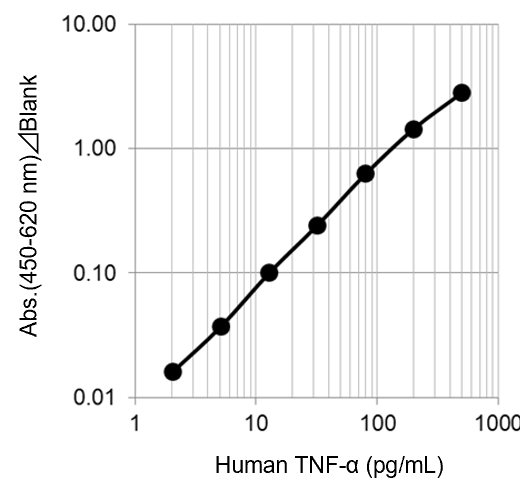
Measurement of TNF-α in Human Serum and Plasma
| Sample No. | Serum | Plasma (EDTA) |
Plasma (Heparin) |
|||
|---|---|---|---|---|---|---|
| Fujifilm Wako (pg/mL) |
Company A (pg/mL) |
Fujifilm Wako (pg/mL) |
Company A (pg/mL) |
Fujifilm Wako (pg/mL) |
Company A (pg/mL) |
|
| 1 | 2.15 | N.D. | 7.66 | N.D. | 2.39 | N.D. |
| 2 | 19.5 | N.D. | 19.2 | 12.55 | N.D. | N.D. |
| 3 | (1.78) (Reference values) |
N.D. | 2.17 | N.D. | 2.87 | N.D. |
| 4 | N.D. | N.D. | N.D. | N.D. | N.D. | N.D. |
| 5 | 3.26 | N.D. | N.D. | N.D. | 1.63 (Reference values) |
N.D. |
| 6 | N.D. | N.D. | N.D. | N.D. | N.D. | N.D. |
| 7 | (1.75) (Reference values) |
N.D. | 9.77 | N.D. | 1.89 (Reference values) |
N.D. |
| 8 | N.D. | N.D. | N.D. | N.D. | 1.65 (Reference values) |
N.D. |
| 9 | N.D. | N.D. | 2.17 | N.D. | 2.38 | N.D. |
| 10 | (1.54) (Reference values) |
N.D. | 1.49 (Reference values) |
N.D. | 1.93 (Reference values) |
N.D. |
N.D.: Below the lower limit of quantification
[Result]
This product was able to detect TNF-α even in samples that were below the lower limit of quantification of another manufacturer's kit.
LBIS™ Mouse TNF-α ELISA Kit
LBIS™ Mouse TNF-α ELISA Kit is a sandwich ELISA kit for the quantitative measurement of mouse TNF-α. This kit enables highly sensitive quantification of TNF-α in biological samples. The standard included in the kit is a recombinant protein produced in Escherichia coli.
Kit Performance
| Assay target | TNF-α |
|---|---|
| Calibration curve range | 3.58 - 700 pg/mL |
| Analysis sample | Mouse Serum/Plasma (EDTA・Heparin) |
| Sample volume | 50 μL (2x dilution) |
| Measurement duration | Approx. 3 hours and 50 minutes |
| Wavelength | Primary wavelength : 450 nm Reference wavelength : 620 nm |
Example of Calibration Curve
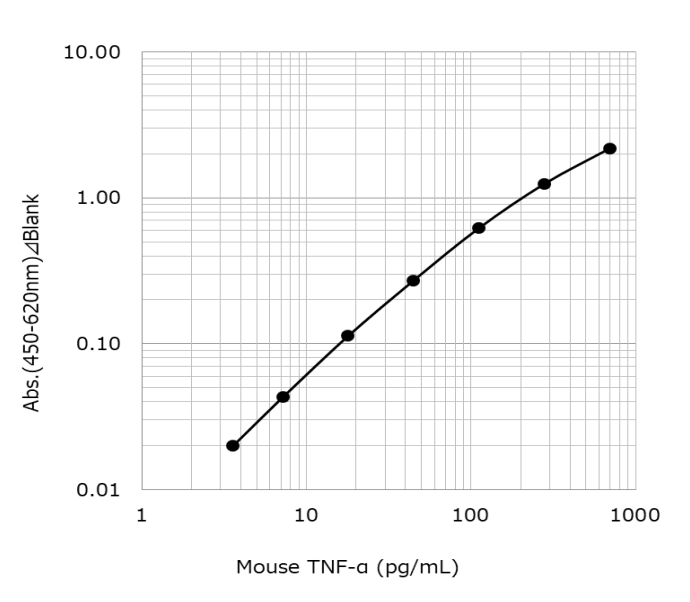
Measurement of TNF-α in Mouse Serum and Plasma
Sample: BALB/c, Male, 8-weeks old, 16-hour fast
| Sample No. | Serum | Plasma (EDTA) |
Plasma (Heparin) |
|||
|---|---|---|---|---|---|---|
| Fujifilm Wako (pg/mL) |
Company A (pg/mL) |
Fujifilm Wako (pg/mL) |
Company A (pg/mL) |
Fujifilm Wako (pg/mL) |
Company A (pg/mL) |
|
| 1 | 5.1 | N.D. | 3.2 | N.D. | 4.66 | N.D. |
| 2 | 3.72 | N.D. | 3.61 | N.D. | 3.39 | 3.56 (Reference values) |
| 3 | 4.49 | N.D. | 3.66 | N.D. | 4.24 | N.D. |
| 4 | 3.84 | N.D. | 1.47 (Reference values) |
N.D. | 3.25 | N.D. |
| 5 | 4.2 | N.D. | 5.04 | N.D. | 2.77 | 4.08 (Reference values) |
N.D.: Below the lower limit of quantification
[Result]
This product was able to detect TNF-α even in samples that were below the lower limit of quantification of another manufacturer's kit.
References
- Okada, M.: Journal of JCS Cardiologist, 7(2), 259(1999). (Japanese)
tumor necrosis factor-α : TNF-α - Horiuchi, T. et al.: Rheumatology., 49(7), 1215(2010).
Transmembrane TNF-α : structure, function and interaction with anti-TNF agents - Horiguchi, H. et al.: The Journal of Showa University Dental Society, 26(2), 125(2006). (Japanese)
The Role of NF-κB in TNF-α-Induced Apoptosis in Human Chondrocyte-Like Cells (USAC)
Product List
- Open All
- Close All
TNF-α ELISA Kit (Human)
TNF-α ELISA Kit (Mouse)
For research use or further manufacturing use only. Not for use in diagnostic procedures.
Product content may differ from the actual image due to minor specification changes etc.
If the revision of product standards and packaging standards has been made, there is a case where the actual product specifications and images are different.