



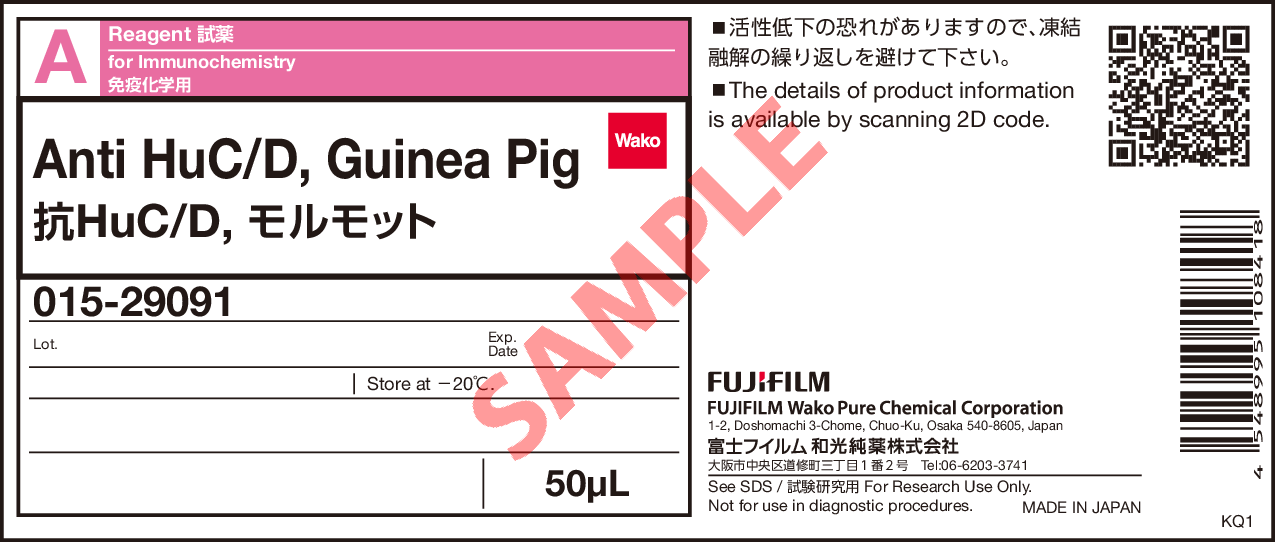
Anti HuC/D, Guinea Pig
- for Immunochemistry
- Manufacturer :
- FUJIFILM Wako Pure Chemical Corporation
- Storage Condition :
- Keep at -20 degrees C.
-
 Close
Close
- Structural Formula
- Label
- Packing
- SDS
|
Comparison
|
Product Number
|
Package Size
|
Price
|
Availability
|
Certificate of Analysis
|
Purchase |
|---|---|---|---|---|---|---|
|
|
|
50uL
|
|
In stock in Japan |
※Check availability in the US with the distributor.
Document
Product Overview
Hu proteins are RNA-binding proteins which are thought to regulate mRNA stability and translational efficiency. Among the Hu proteins, HuB, HuC, and HuD are specifically expressed in neurons and contribute to neuronal differentiation and maintenance. In immunohistochemistry, anti-HuC/D antibodies are commonly used as neuron-specific markers.
The “Anti HuC/D, Guinea Pig” is a guinea pig polyclonal antibody, raised against HuC/D. It can be used to perform multiplex immunohistochemistry.
Antibody Information
| Clonality | Polyclonal |
|---|---|
| Antigen | Synthetic peptide (internal region of HuC/D) |
| Host | Guinea pig |
| Formulation | Antiserum diluted in PBS |
| Conjugate | Unconjugated |
| Cross-reactivity | Mouse, Rat |
| Application | Immunohistochemistry (Frozen Section) 1:1,500 |
Protocol (Example)
- Perfusion fixation
- Perfuse with sodium citrate/PBS to remove blood, followed by perfusion with 4 % PFA.
- Post-fixation
- 4 % PFA (-24 hours)
- Immersion in sucrose
- 30 % Sucrose/PBS (4 ℃, from overnight to approximately 2 days)
- Preparation of frozen sections
- After removing sucrose, prepare frozen blocks and cut 30 μm thick sections using a cryostat.
- Glycine treatment
- 25 mM glycine/PBS (Approximately 20 minutes)
- Blocking
- 5 % normal goat serum in 0.3 % Triton X-100/PBS (4 ℃, Overnight)
- Primary antibody reaction
- Anti HuC/D, Guinea pig (1:1,500), 1 % normal goat serum in 0.3 % Triton X-100/PBS (4 ℃, from overnight to 2 days).
- Washing
- 0.3 % TritonX-100/PBS (5 minutes×3)
- Secondary antibody reaction
- Alexa Fluor® 488 AffiniPure Goat Anti-Guinea Pig IgG (H+L) (1:500), 1 % normal goat serum in 0.3 % Triton X-100/PBS (RT, 2 hours)
- Washing
- 0.3 % TritonX-100/PBS (5 minutes×3)
- Mounting
- The sample is sealed in mounting medium and stored at 4 ℃ in a dark place.
Data
Application Data
Immunohistochemistry
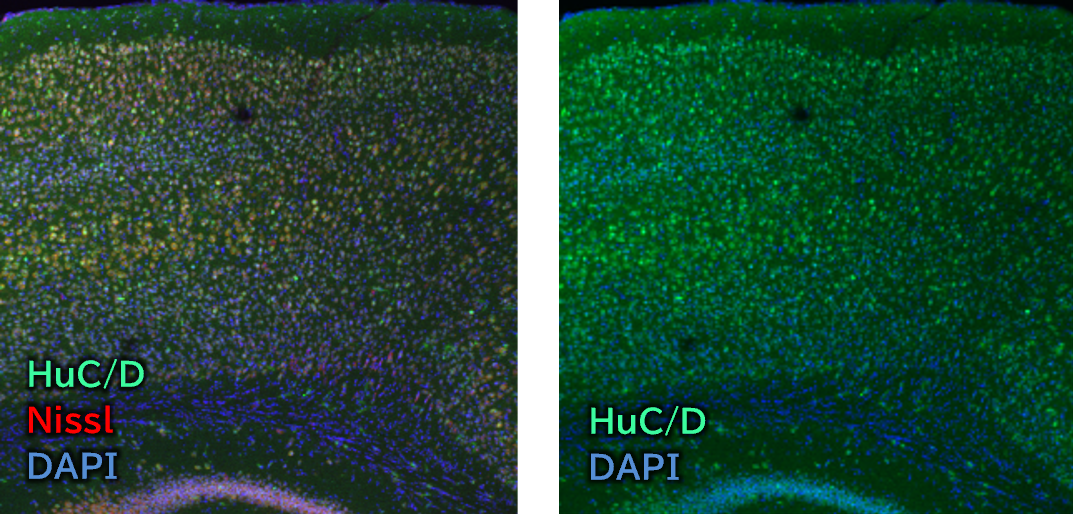
Species: Mouse
Site: Cerebral cortex
Sample: Frozen section
Antibody concentration: 1:1,500
Data by courtesy of
Dr. Miyata, Department of Applied Biology, Kyoto Institute of Technology
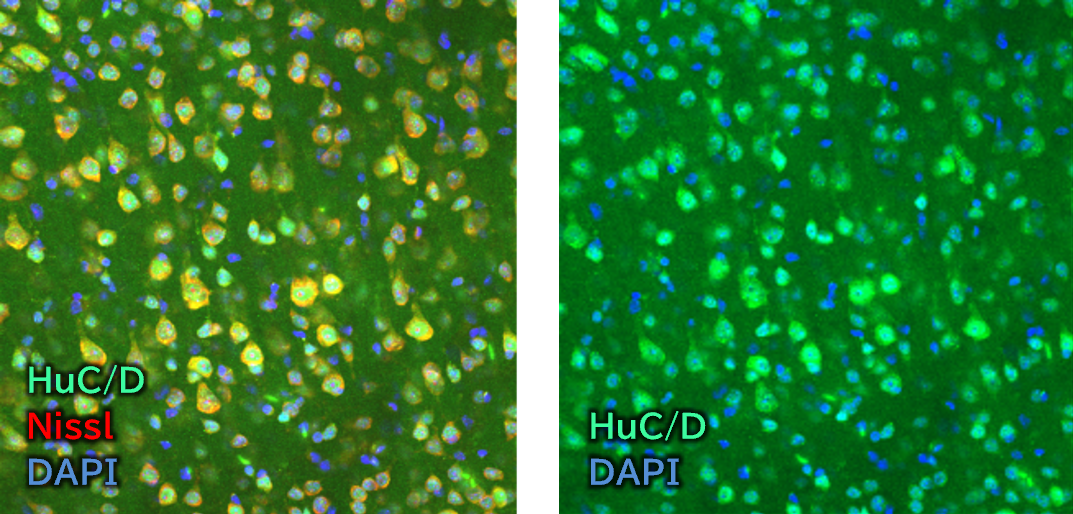
Species: Mouse
Site: Cerebral cortex (Layer V)
Sample: Frozen section
Antibody concentration: 1:1,500
Data by courtesy of
Dr. Miyata, Department of Applied Biology, Kyoto Institute of Technology
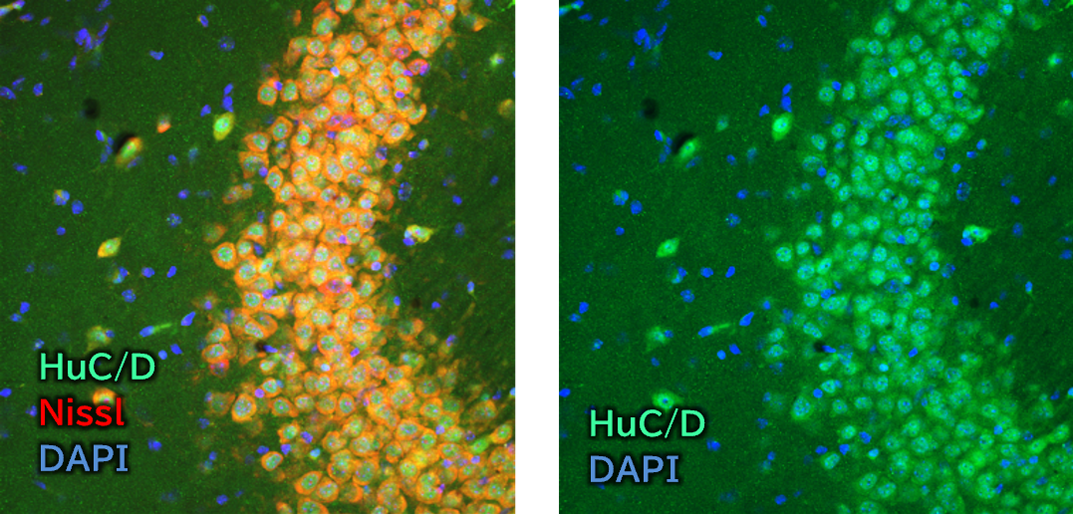
Species: Mouse
Site: Hippocampus (CA3)
Sample: Frozen section
Antibody concentration: 1:1,500
Data by courtesy of
Dr. Miyata, Department of Applied Biology, Kyoto Institute of Technology
FAQ
About protocol
- What secondary antibodies can be used?
- At Fujifilm Wako, the following secondary antibodies have been successfully used:
Alexa Fluor® 488 AffiniPure Goat Anti-Guinea Pig IgG (H+L) (Jackson ImmunoResearch, Product Number: 106-545-003)
About application
- What animals can this antibody be used for?
- Fujifilm Wako has confirmed that it can be used for mice and rats. Other species have not been tested.
Overview / Applications
| Outline | Hu protein is an embryonic lethal abnormal visual system (ELAV)-like neuronal RNA-binding protein that contains three RNA recognition motifs. HuC/D is expressed specifically in neurons and is useful as a marker for neurons in tissues. Anti HuC/D, Guinea Pig is a guinea pig polyclonal antibody that reacts with HuC/D. [Antigen] Synthetic peptide corresponding to the internal sequence of HuC/D [Species cross reactivity] Mouse and rat [Application] Immunohistochemistry(frozen section) 1:1,500 |
|---|---|
| Precautions for Use | Avoid repeated freeze and thaw. |
Property
| Appearance | Liquid |
|---|---|
| Composition | Antiserum diluted in PBS |
Manufacturer Information
Alias
- HuC/D antibody
For research use or further manufacturing use only. Not for use in diagnostic procedures.
Product content may differ from the actual image due to minor specification changes etc.
If the revision of product standards and packaging standards has been made, there is a case where the actual product specifications and images are different.