



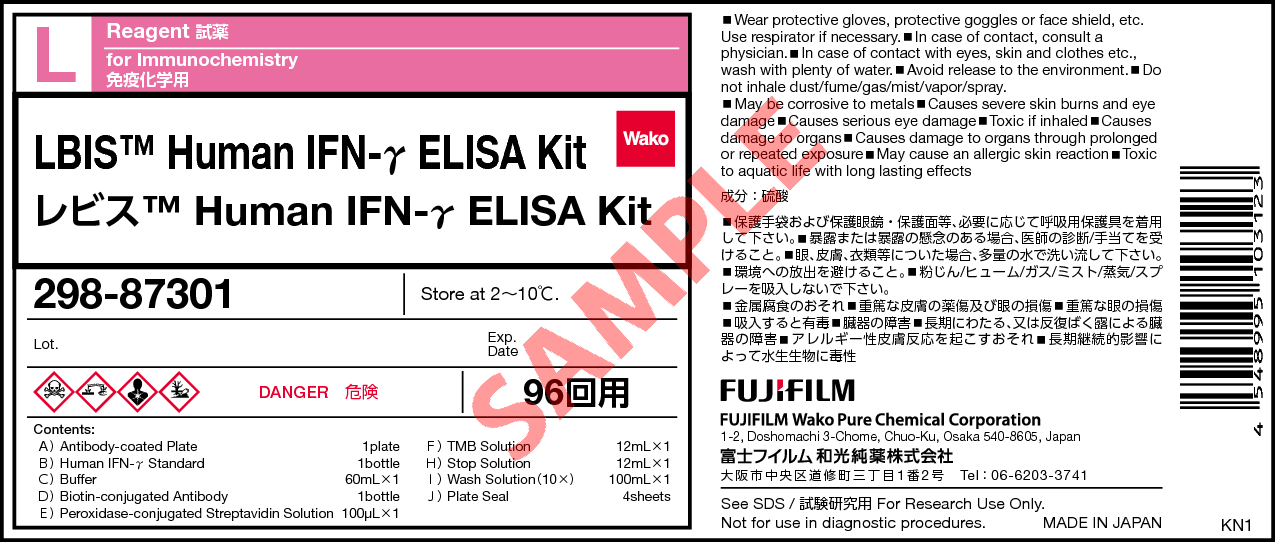
LBIS (TM) Human IFN-γ ELISA Kit
- for Immunochemistry
- Manufacturer :
- FUJIFILM Wako Pure Chemical Corporation
- Storage Condition :
- Keep at 2-10 degrees C.
-
 Close
Close
- Structural Formula
- Label
- Packing
|
Comparison
|
Product Number
|
Package Size
|
Price
|
Inventory
|
|
|---|---|---|---|---|---|
|
|
|
96Tests
|
|
In stock in Japan |
Document
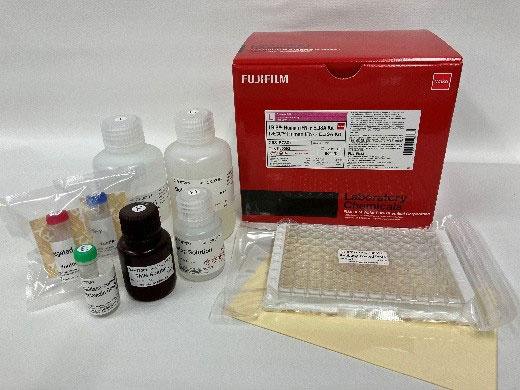
Kit component
96 tests
| Antibody-coated Plate | 96 wells/1 plate |
|---|---|
| Human IFN-γ Standard | 1 bottle |
| Buffer | 60 mL/1 bottle |
| Biotin-conjugated Antibody | 1 bottle |
| Peroxidase-conjugated Streptavidin Solution | 100 μL/1 bottle |
| TMB Solution | 12 mL/1 bottle |
| Stop Solution | 12 mL/1 bottle |
| Wash Solution (10x) | 100 mL/1 bottle |
| Plate Seal | 4 sheets |
Product Overview
Interferon-γ (IFN-γ) is an important cytokine involved in both innate and adaptive immunity. Cells known to produce IFN-γ include natural killer (NK) cells and T cells. Secreted IFN-γ induces a wide range of immune responses, including antiviral activity, activation of macrophages, maturation of dendritic cells, and induction of T-cell differentiation. IFN-γ also plays a significant role in antitumor immunity, with reported effects including suppression of metastasis, induction of apoptosis, and inhibition of angiogenesis.
LBIS™ Human IFN-γ ELISA Kit is a sandwich ELISA kit for the quantitative measurement of human IFN-γ. This kit enables highly sensitive quantification of IFN-γ in biological samples. The standard included in the kit is a recombinant protein produced in Escherichia coli.
Kit Performance
| Assay target | IFN-γ |
|---|---|
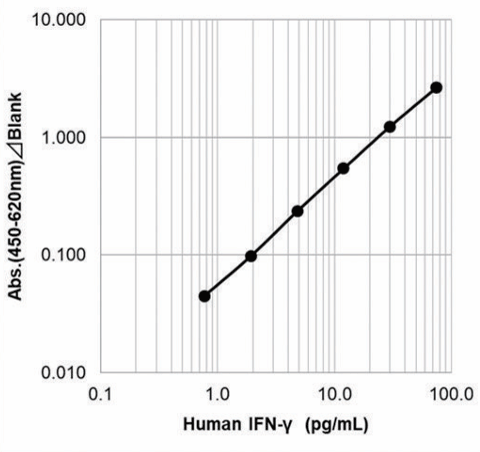
| Calibration curve range | 0.768-75.0 pg/mL |
| Analysis sample | Human Serum/Plasma (EDTA, heparin) /Cell culture supernatant* |
| Sample amount | 50 μL (2x dilution) |
| Measurement duration | Approx 2 hours and 20 minutes |
| Wavelength | Primary wavelength : 450 nm Reference wavelength : 620 nm |
Example of Calibration Curve
Data
Repeatability (within run precision)
Repeatability was conducted by measuring fivefold assays of human serum samples at two concentrations.
| n\ID | ID1 (pg/mL) | ID2 (pg/mL) |
|---|---|---|
| 1 | 26.1 | 1.41 |
| 2 | 26.4 | 1.42 |
| 3 | 26.2 | 1.44 |
| 4 | 26.3 | 1.46 |
| 5 | 26.4 | 1.43 |
| mean | 26.3 | 1.43 |
| SD | 0.13 | 0.019 |
| CV(%) | 0.50 | 1.3 |
- [Result]
- The CV (%) of human serum was 0.50-1.3%, indicating good repeatability.
Reproducibility (between run precision)
Reproducibility was conducted by measuring human serum samples at three concentrations in triplicate each for four days.
| Day\ID | ID3 (pg/mL) | ID4 (pg/mL) | ID5 (pg/mL) |
|---|---|---|---|
| 1 | 29.1 | 4.90 | 0.742 |
| 2 | 29.9 | 4.69 | 0.723 |
| 3 | 31.2 | 4.87 | 0.785 |
| 4 | 29.5 | 4.99 | 0.772 |
| mean | 29.9 | 4.86 | 0.756 |
| SD | 0.91 | 0.13 | 0.028 |
| CV(%) | 3.0 | 2.6 | 3.7 |
- [Result]
- The CV (%) of human serum was 2.6-3.7%, indicating good reproducibility.
Dilution Linearity Test
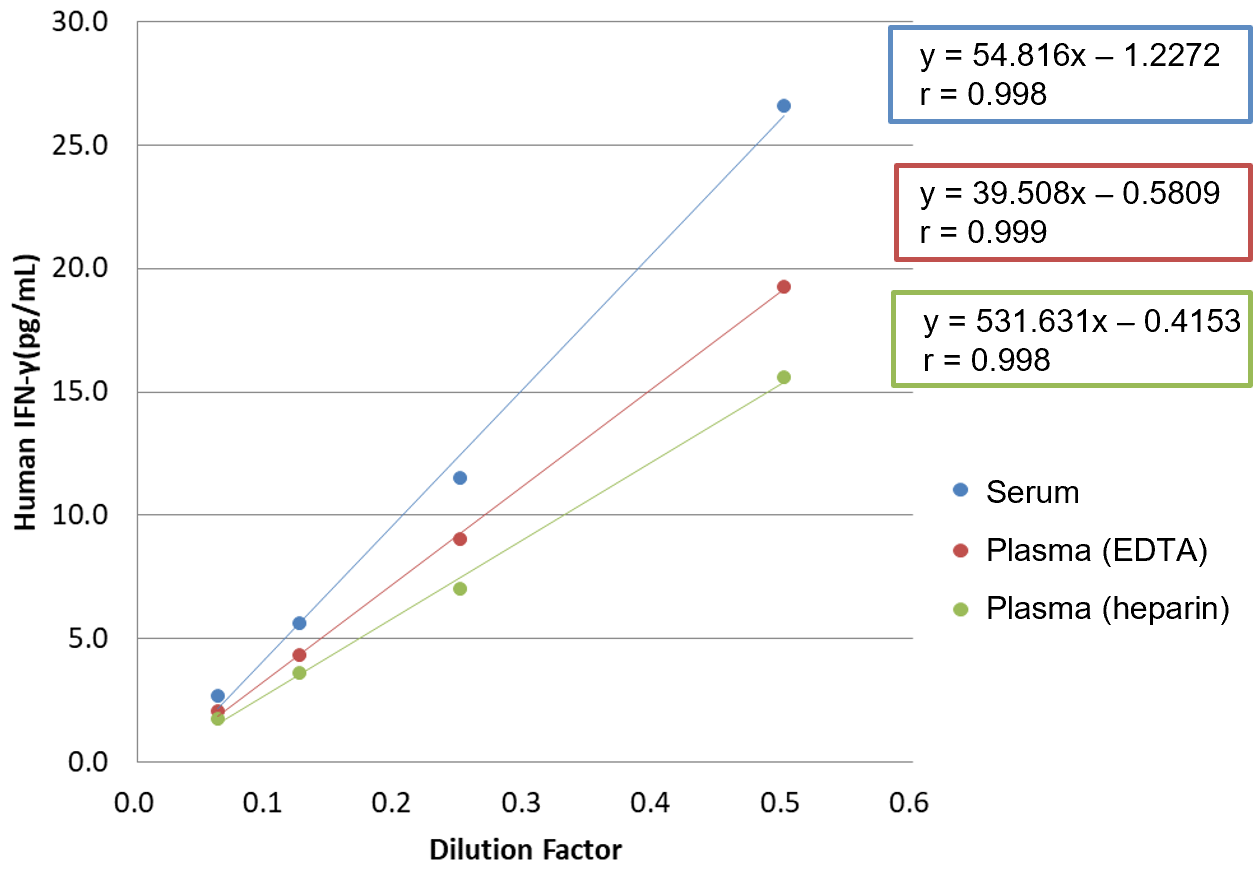
Human serum and plasma (EDTA/heparin), as well as cell culture supernatant spiked with the standard, were serially diluted twofold using the provided buffer and measured in duplicate to evaluate linearity.
Human serum/plasma (EDTA, heparin)
Human PBMC supernatants ± PHA stimulation (in RPMI-1640 medium with 10% FBS)
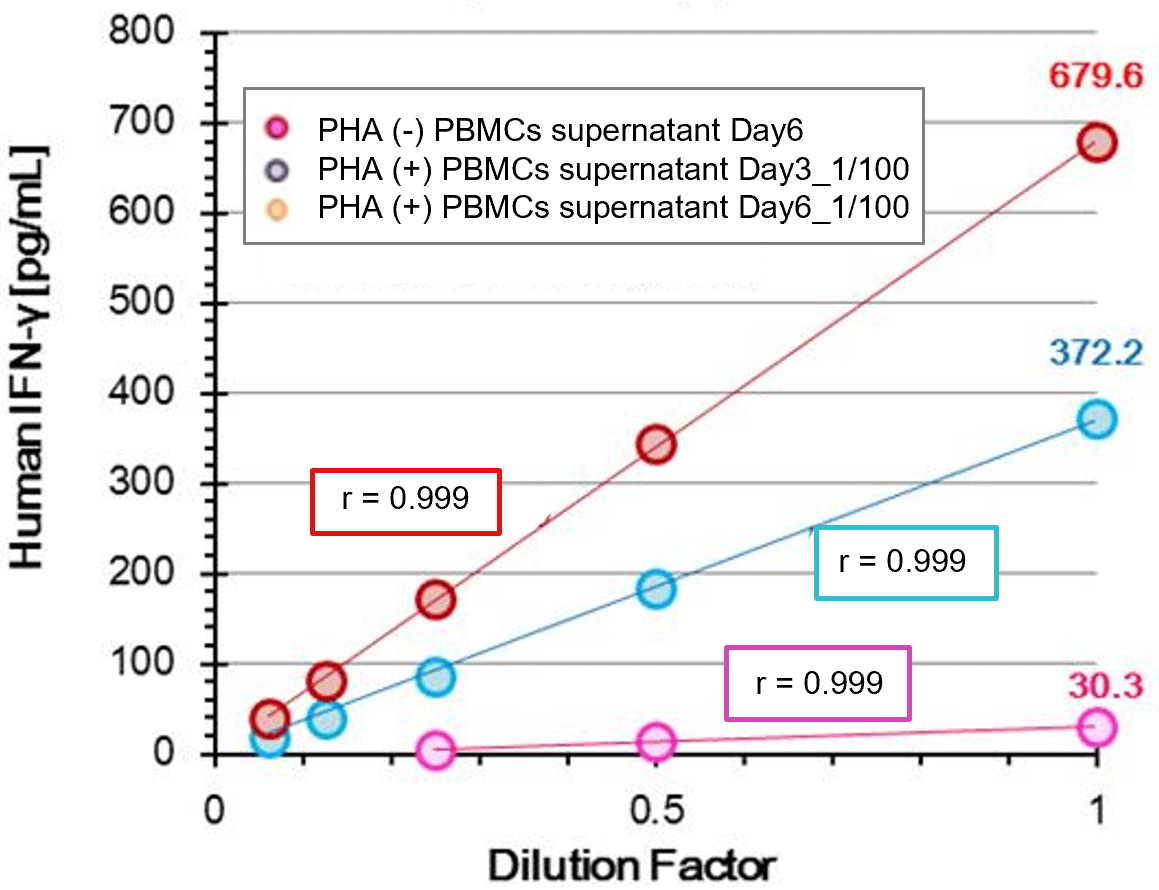
Human PBMC supernatants stimulated with PHA (phytohemagglutinin, simulating IFN-γ secretion) for 3 or 6 days were measured at 1:100 dilution.
- [Result]
- All measurement results showed good linearity within the measurement range.
Spike and Recovery Test
Standard solutions at three concentrations were added to human serum/plasma (EDTA/heparin), then spike recovery tests were conducted, with each measurement performed in duplicate.
Human serum
| Spiked amount (pg/mL) |
Measurement value (pg/mL) |
Recovery amount (pg/mL) |
Recovery (%) |
|---|---|---|---|
| - | 0.516 | - | - |
| 1.00 | 1.60 | 1.08 | 108 |
| 4.00 | 4.50 | 3.98 | 99.5 |
| 16.0 | 16.4 | 15.9 | 99.4 |
| mean | 102 | ||
Human plasma (EDTA)
| Spiked amount (pg/mL) |
Measurement value (pg/mL) |
Recovery amount (pg/mL) |
Recovery (%) |
|---|---|---|---|
| - | 0.708 | - | - |
| 1.00 | 1.76 | 1.05 | 105 |
| 4.00 | 4.47 | 3.76 | 94.0 |
| 16.0 | 15.1 | 14.4 | 90.0 |
| mean | 96.3 | ||
Human plasma (heparin)
| Spiked amount (pg/mL) |
Measurement value (pg/mL) |
Recovery amount (pg/mL) |
Recovery (%) |
|---|---|---|---|
| - | 0.618 | - | - |
| 1.00 | 1.62 | 1.00 | 100 |
| 4.00 | 4.20 | 3.58 | 89.6 |
| 16.0 | 14.5 | 13.9 | 86.8 |
| mean | 92.2 | ||
- [Result]
- Good recovery rates were confirmed.
Cross-reactivity with similar proteins
Proteins similar to human IFN-γ, including IFN-γ of other species and human IFN-γR1 (IFN-γ Receptor 1), were tested to determine if they could be detected.
| Spiked amount (ng/mL) |
Measurement value (ng/mL) |
Cross-reactivity (%) |
|
|---|---|---|---|
| Mouse IFN-γ | 2 | N.D. | - |
| 10 | N.D. | - | |
| 50 | N.D. | - | |
| Rat IFN-γ | 2 | N.D. | - |
| 10 | N.D. | - | |
| 50 | N.D. | - | |
| Dog IFN-γ | 2 | N.D. | - |
| 10 | 0.0152 | 0.15 | |
| 50 | 0.0983 | 0.20 | |
| Bovine IFN-γ | 2 | N.D. | - |
| 10 | N.D. | - | |
| 50 | N.D. | - | |
| Monkey IFN-γ | 2 | 0.0206 | 1.03 |
| 10 | 0.1527 | 1.53 | |
| Rabbit IFN-γ | 2 | N.D. | - |
| 10 | N.D. | - | |
| 50 | N.D. | - | |
| Human IFN-γR1 | 2 | N.D. | - |
| 10 | N.D. | - | |
| 50 | N.D. | - |
N.D.: Below the lower limit of quantification
Red: Values outside the quantification range; shown as reference
- [Result]
- Very low reactivity with similar proteins was confirmed.
Example of Sample Measurement
Human serum and plasma (EDTA/heparin) samples were measured and compared using this kit and the competitor.
Human serum
| ID\n | Fujifilm Wako (pg/mL) |
Company A (pg/mL) |
|---|---|---|
| 1 | 0.821 | N.D. |
| 2 | 1.21 | N.D. |
| 3 | N.D. | N.D. |
| 4 | N.D. | N.D. |
| 5 | 2.02 | N.D. |
| 6 | N.D. | N.D. |
| 7 | 2.02 | N.D. |
| 8 | 1.43 | N.D. |
| 9 | 0.974 | N.D. |
| 10 | 1.71 | N.D. |
Human plasma (heparin)
| ID\n | Fujifilm Wako (pg/mL) |
Company A (pg/mL) |
|---|---|---|
| 21 | N.D. | N.D. |
| 22 | N.D. | N.D. |
| 23 | 2.68 | N.D. |
| 24 | 1.28 | N.D. |
| 25 | 1.39 | N.D. |
| 26 | N.D. | N.D. |
| 27 | 0.865 | N.D. |
| 28 | 3.00 | 8.92 |
| 29 | 2.75 | N.D. |
| 30 | 2.44 | N.D. |
N.D.: Below the lower limit of quantification
Human PBMC supernatants ± PHA stimulation (in RPMI-1640 medium with 10% FBS)
| Samples | Fujifilm Wako (pg/mL) | Company A (pg/mL) |
|---|---|---|
| RPMI-1640 + 10% FBS | N.D. | N.D. |
| PHA (-) human PBMC | N.D. | N.D. |
| PHA (+) human PBMC | 12,385 | 16,224 |
N.D.: Below the lower limit of quantification
- [Result]
- This product was able to detect and quantify IFN-γ in human serum/plasma samples in which IFN-γ was not detected using the other manufacturer's product. With both products, IFN-γ levels were below the limit of quantification in the control medium and in culture supernatants of human PBMCs without PHA stimulation. In contrast, elevated IFN-γ levels were confirmed in culture supernatants of PHA-stimulated cells.
FAQ
About samples
- What anticoagulants should I use?
- We recommend using EDTA or heparin as anticoagulant.
- How should I store and prepare the samples?
- Samples should be immediately assayed or stored below -35℃ until assay. Before starting assay, shake thawed samples sufficiently. Do not repeat freeze-and-thaw cycles. Dilution of a sample should be made in a PP or PE test tube using the provided buffer prior to adding them to wells.
About kit usage
- What instruments, and equipment are required for the assay using this kit?
- The instruments and equipment required for the use of this kit are listed below;
- Deionized water (or distilled water)
- Test tubes for preparation of standard solution series
- Glassware for dilution of Wash Solution (10x) (a graduated cylinder, a bottle)
- Pipettes (disposable tip type). One should be able to deliver 50 μL precisely, and another for 100 – 1,000 μL
- Syringe-type repeating dispenser like Eppendorf multipette plus which can dispense 100 μL
- Paper towel to remove washing buffer remaining in wells
- A vortex-type mixer
- A shaker for 96 well-plate (600 – 1,200 rpm)
- An automatic washer for 96 well-plate (if available), or a wash bottle with a jet nozzle
- A 96 well-plate reader (450 ± 10 nm, 620 nm :600 - 650 nm)
- Software for data analysis
- How should I use the human IFN-γ standard?
- The amount of purified water to be added varies by lot. Please reconstitute the human IFN-γ standard with the amount of purified water specified in the “Reconstitution of standard” section on this product page to prepare the original standard solution (750 pg/mL). Then, dilute the solution using the kit-provided buffer that has been equilibrated to room temperature.
- What are the storage conditions for each reagent?
- Buffer & TMB Solution
Use only volume you need for your assay. Remaining reagents should be stored at 2-10℃ closing the cap tightly. Once opened, we recommend using as soon as possible to avoid influence by environmental condition.
Stop Solution
Close the cap tightly and store at 2-10℃.
Human IFN-γ Standard & Biotin-conjugated Antibody
The reconstituted standard solution (original standard solution) should be used within 2 weeks if stored in a refrigerator. Dispose the remaining diluted standard solutions after use.
Peroxidase-conjugated Streptavidin Solution
Remaining working solution (already diluted) should be disposed. The rest of the undiluted solution (unused): close the cap tightly and store at 2-10℃. Once opened, we recommend using as soon as possible to avoid influence by environmental condition.
Prepare reagent solutions in appropriate volume for your assay.
Overview / Applications
Property
Manufacturer Information
Alias
- 631-47891 (Previous Code)
AKH-IFNG (Previous Code)
For research use or further manufacturing use only. Not for use in diagnostic procedures.
Product content may differ from the actual image due to minor specification changes etc.
If the revision of product standards and packaging standards has been made, there is a case where the actual product specifications and images are different.