



Anti Amyloid β Antibodies
Amyloid β (Aβ) is a peptide of approximately 40 amino acids and is the major component of senile plaques, a pathological hallmark of Alzheimer's disease. Aβ is classified into several isoforms based on amino acid length, each differing in aggregation tendency and cytotoxicity. The amino acid sequence of Aβ also varies across animal species, and these differences are believed to influence the aggregation tendency of endogenous Aβ. It is therefore important to select an appropriate antibody based on the Aβ isoform of interest when designing experiments.
Fujifilm Wako offers anti-amyloid β (Aβ) mouse monoclonal antibodies originally developed by Takeda Pharmaceutical Company. Thanks to their excellent specificity and reactivity, these antibodies are widely used by researchers around the world and have been featured in numerous publications. Four antibodies with distinct recognition sites are available, allowing users to select the most appropriate antibody for each application.
What is Amyloid β (Aβ) ?
Amyloid β (Aβ) is a peptide of approximately 40 amino acids and is the major component of senile plaques, a pathological hallmark of Alzheimer’s disease. According to the amyloid cascade hypothesis, Aβ accumulation is the initiating event, leading to neurofibrillary tangles and neurodegeneration, ultimately resulting in cognitive impairment. Studies have shown that Aβ begins to accumulate gradually two decades or more before the clinical onset of Alzheimer’s disease1), and early detection is expected to open new avenues for its prevention and treatment.
Aβ exists as several isoforms that differ in amino acid length. Neurons primarily secrete Aβ40 and Aβ42, with Aβ40 typically being the more abundant form. Aβ42, however, exhibits higher aggregation tendency and cytotoxicity and is thought to be more closely linked to the onset and progression of Alzheimer’s disease. Aβ is generated through sequential cleavage of its precursor, amyloid precursor protein (APP), by β-secretase followed by γ-secretase. Notably, γ-secretase acts via a successive cleavage mechanism, processing the substrate in consecutive steps2-3), and its activity is known to determine the ratio of Aβ isoforms produced.
Aβ sequences are also known to differ across animal species. Mouse Aβ differs from human Aβ by three amino acids at the N-terminus, and antibodies that recognize the human Aβ N-terminus may therefore not cross-react with mouse Aβ. These amino acid differences are believed to underlie the distinct aggregation properties of endogenous Aβ in mice versus humans, which is why the mouse Aβ sequence has been humanized in certain mouse models of Alzheimer’s disease4). When using mice or rats as experimental models, it is essential to select antibodies that account for these species-specific differences in Aβ.
Product Lineup
Fujifilm Wako offers anti-amyloid β (Aβ) mouse monoclonal antibodies originally developed by Takeda Pharmaceutical Company. Thanks to their excellent specificity and reactivity, these antibodies are widely used by researchers around the world and have been featured in numerous publications2,5-9). Four antibodies with distinct recognition sites are available, allowing users to select the most appropriate antibody for each application.
| Clone No. | BAN50 | BNT77 | BA27 | BC05 | ||
|---|---|---|---|---|---|---|
| Product No. | 013-26873 | 010-26883 | 014-26923 | 010-26903 | ||
| Recognition Site | Aβ N-terminal | Aβ central region (11–28 a.a.) | Aβ40 C-terminal | Aβ42/43 C-terminal | ||
| Host | Mouse | Mouse | Mouse | Mouse | ||
| Isotype | IgG1・κ | IgA・κ | IgG2a・κ | IgG1・κ | ||
| Application | ELISA, ICC, IHC, IP, WB | ELISA, IHC, IP | ELISA, IHC, WB | ELISA, IHC, WB | ||
| Concentration | 0.9-1.3 mg/mL | 0.9-1.3 mg/mL | 0.9-1.3 mg/mL | 0.9-1.3 mg/mL | ||
| Cross-reactivity | Human | Aβ40 | ● | ● | ● | |
| Aβ42 | ● | ● | ● | |||
| Aβ43 | ● | ● | ● | |||
| Mouse Rat |
Aβ40 | ● | ● | |||
| Aβ42 | ● | ● | ||||
| Aβ43 | ● | ● | ||||
Abbreviation → ELISA: Enzyme-linked Immunosorbent Assay, ICC: Immunocytochemistry, IHC: Immunohistochemistry, IP: Immunoprecipitation, WB: Western blotting
Data
Immunohistochemistry
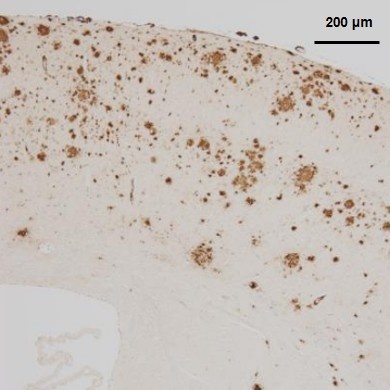
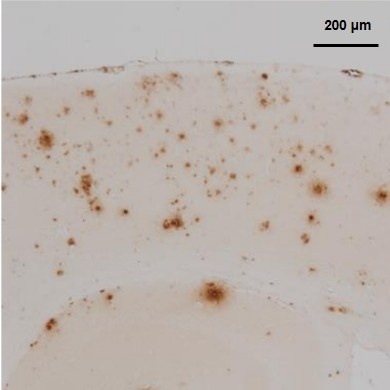
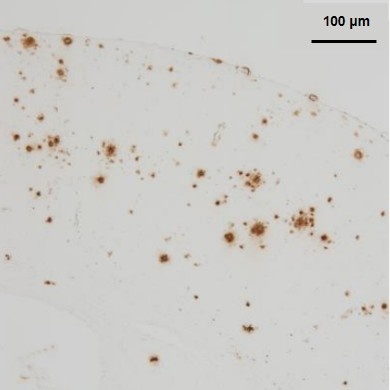
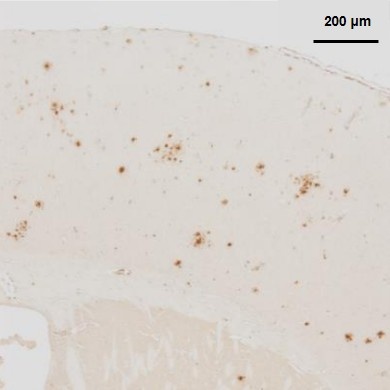
Sample
- Species:
- 15-month-old APP/PS1 line AD model mouse,B6.Cg-Tg (APPswe, PSEN1dE9)
85Dbo/Mmjax - Site:
- Piriform cortex
- Sample:
- Paraffin sections
Condition
- Antigen retrieval
- BAN50:
- Microwave treatment in citrate buffer + proteinase K
BNT77/BA27/BC05: Formic acid treatment
- Detection
Biotin-conjugated antibody, Avidin-biotin system + DAB staining
Data by courtesy of Drs. Kokawa, A., Hashimoto, T., and Iwatsubo, T., Graduate School of Medicine, University of Tokyo in Japan.
Western blotting
Detection of Soluble Aβ
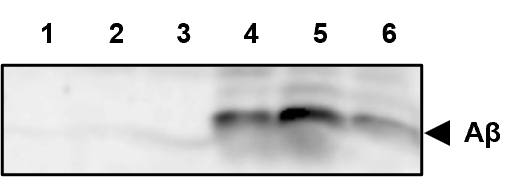
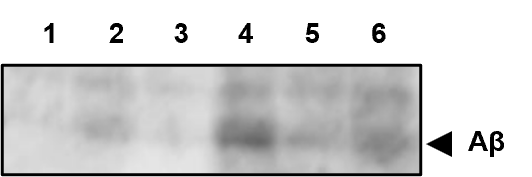
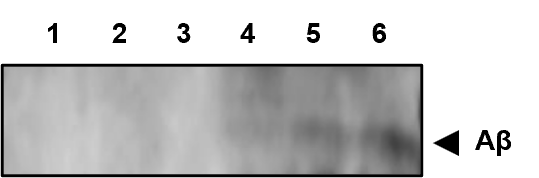
Sample
- Lane 1-3:
- TBS brain extracts from WT mice
- Lane 4-6:
- TBS brain extracts from 15-monthsold APP/PS1 AD model mice, B&.Cg-Tg (APPswe. PSEN1dE9)
Condition
Applied amount: 30 μg/Lane
Reduction treated
Data by courtesy of Drs. Hashimoto, T., and Iwatsubo, T., Graduate School of Medicine, University of Tokyo in Japan.
Bulk Supply of Antibody
Fujifilm Wako also offers bulk supply of this product (mg scale). Testing for antibody activity (titer) and protein concentration can also be performed upon request. For inquiries, please contact us at ffwk-labchem-tec@fujifilm.com.
Please note that, depending on your specific requirements, bulk supply may not be available, or delivery may take additional time.
Certain products may not be available for commercial use. For commercial applications, please contact Fujifilm Wako prior to such use.
References
- Bateman, R. J. et al.: N. Engl. J. Med., 367(9) , 795(2012).
Clinical and biomarker changes in dominantly inherited Alzheimer's disease - Qi-Takahara, Y. et al.: J. Neurosci., 25(2), 436(2005).
Longer forms of amyloid beta protein: implications for the mechanism of intramembrane cleavage by gamma-secretase - Takami, M. et al.: J. Neurosci., 29(41), 13042(2009).
gamma-Secretase: successive tripeptide and tetrapeptide release from the transmembrane domain of beta-carboxyl terminal fragment - Saito, T. et al.: Nat. Neurosci., 17(5), 661(2014).
Single App knock-in mouse models of Alzheimer's disease - Asami-Odaka, A. et al.: Biochemistry, 34(32), 10272(1995).
Long amyloid beta-protein secreted from wild-type human neuroblastoma - Iwata, H. et al.: J. Biol. Chem., 276(24), 21678(2001).
Subcellular compartment and molecular subdomain of beta-amyloid precursor protein relevant to the Abeta 42-promoting effects of Alzheimer mutant presenilin 2 - Tomita, T. et al.: J. Neurosci., 19(24), 10627(1999).
C terminus of presenilin is required for overproduction of amyloidogenic Abeta42 through stabilization and endoproteolysis of presenilin - Sudoh, S. et al.: J. Neurochem., 71(4), 1535(1998).
Presenilin 1 mutations linked to familial Alzheimer's disease increase the intracellular levels of amyloid beta-protein 1-42 and its N-terminally truncated variant(s) which are generated at distinct sites - Iwatsubo, T. et al.: Am. J. Pathol., 149(6), 1823(1996).
Full-length amyloid-beta (1-42(43)) and amino-terminally modified and truncated amyloid-beta 42(43) deposit in diffuse plaques
Product List
- Open All
- Close All
Anti Amyloid β (Aβ) , Monoclonal Antibodies
For research use or further manufacturing use only. Not for use in diagnostic procedures.
Product content may differ from the actual image due to minor specification changes etc.
If the revision of product standards and packaging standards has been made, there is a case where the actual product specifications and images are different.
The prices are list prices in Japan.Please contact your local distributor for your retail price in your region.