



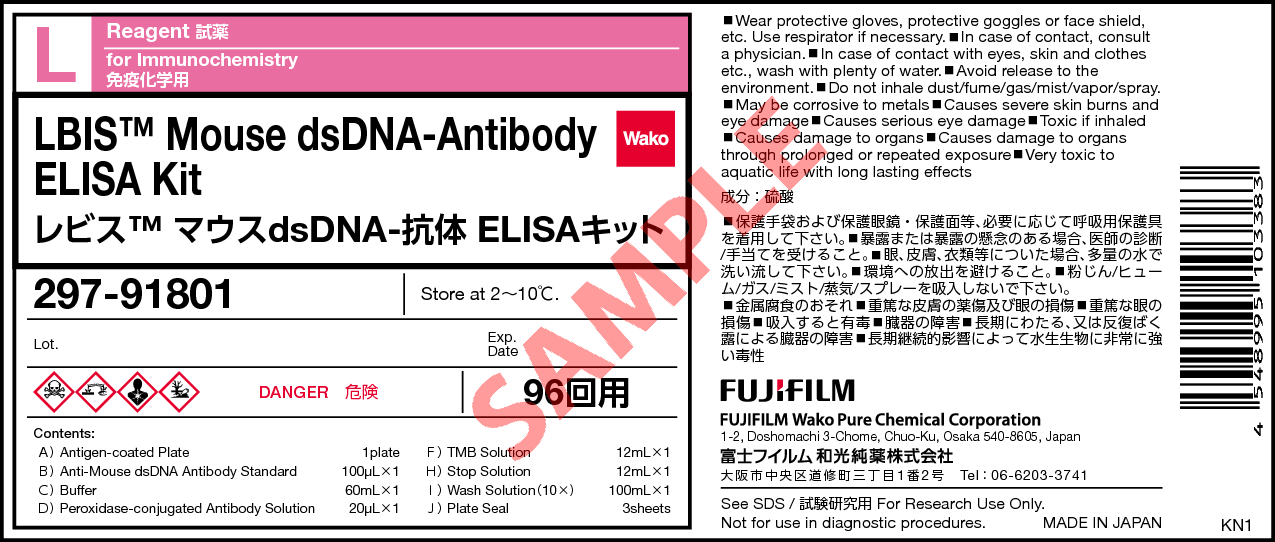
LBIS™ Mouse dsDNA-Antibody ELISA Kit
- for Immunochemistry
- Manufacturer :
- FUJIFILM Wako Pure Chemical Corporation
- Storage Condition :
- Keep at 2-10 degrees C.
- GHS :
-


-
 Close
Close
- Structural Formula
- Label
- Packing
- SDS
|
Comparison
|
Product Number
|
Package Size
|
Price
|
Availability
|
Certificate of Analysis
|
Purchase |
|---|---|---|---|---|---|---|
|
|
|
96Tests
|
|
In stock in Japan |
※Check availability in the US with the distributor.
Document
Kit component
For 96 tests
| (A) Antigen-coated Plate | 96 wells (8×12) / 1 plate |
|---|---|
| (B) Mouse anti-dsDNA Antibody Standard | 100 μL / 1 bottle |
| (C) Buffer | 60 mL / 1 bottle |
| (D) Peroxidase-conjugated Antibody Solution | 20 μL / 1 bottle |
| (F) TMB Solution | 12 mL / 1 bottle |
| (H) Stop Solution | 12 mL / 1 bottle |
| (I) Wash Solution (10×) | 100 mL / 1 bottle |
| (J) Plate Seal | 3 sheets |
Product Overview
Autoantibodies against DNA are IgG or IgM type reacting with natural dsDNA, ssDNA, or both types. Anti-dsDNA antibody is a kind of typical autoantibodies, and anti-dsDNA-IgG antibody is found with high incidence in SLE patient blood. Anti-dsDNA titer in SLE blood closely related to DNA-anti-DNA complex titer and low complement level, and it serves as an important marker for the activity of the disease.
This kit is a sandwich ELISA system for quantitative measurement of mouse anti-dsDNA antibody titer1). It enables numerical comparison between measurements by converting IgG-type dsDNA autoantibody titers in diseased mouse blood to units using a standard antibody titer calibration curve.
Kit Performance
| Analysis sample | Mouse Serum/Plasma |
|---|---|
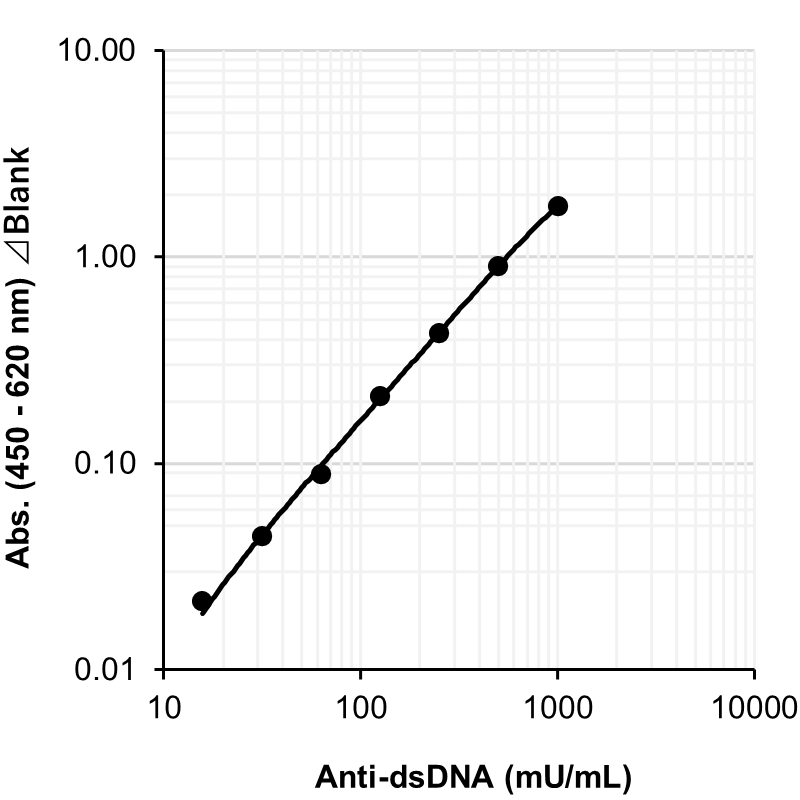
| Calibration curve range | 15.6-1,000 mU/mL |
| Sample volume | 5 µL (requires dilution*) |
| Measurement duration | Approx. 4 hours and 20 minutes |
| Detection method | Colorimetric (Primary: 450 nm / Refference: 620 nm) |
Example of Calibration Curve
Precision
Repeatability (within run precision)
Repeatability was conducted by measuring samples from mouse (n=30) with this product. The average CV (%) was 4.2%, indicating good repeatability.
Reproducibility (between run precision)
Reproducibility was conducted by measuring samples from mouse (n=30) for three days with this product. The average CV (%) was 4.7%, indicating good reproducibility.
Data
Application Data
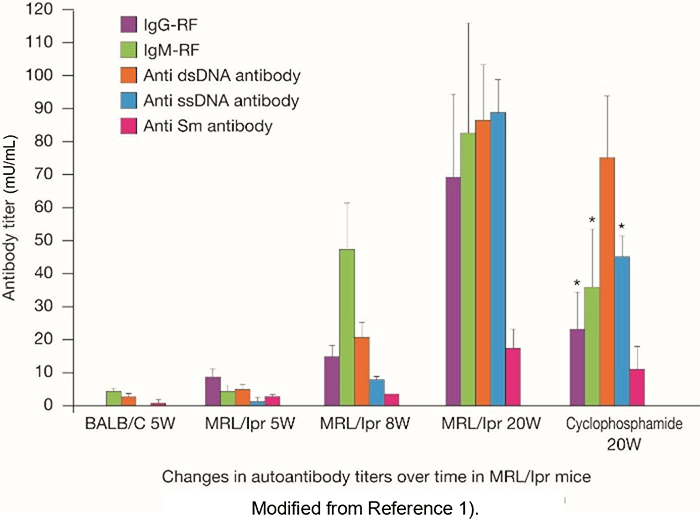
Serum levels of the respective autoantibodies were measured over time in MRL/lpr mice (n=7). The data are presented as the mean ± standard deviation (SD).
[Result]
Autoantibody production increased with age. Treatment significantly reduced the titers of IgG-RF, IgM-RF, and anti-ssDNA antibodies compared with those in 20-week-old MRL/lpr mice (*p<0.05).
References
- Tadahiro K., Masaaki K. and Chiyuki A.: Japanese journal of inflammation, 20 (6), (2000)
A novel assay kits for autoantibodies rate on spontaneous autoimmune model mice
FAQ
About samples
- What are the precautions for processing blood samples?
- Do not use heat-inactivated samples.
- Do not use heparin as anticoagulant.
- To avoid influence of blood (high lipid or hemolysis, etc.), if your original samples have heavy chyle or hemolysis, do not use them for assay.
- Turbid samples or those containing insoluble materials should be centrifuged before testing to remove any particulate matter.
About kit usage
- What instruments, and equipment are required for the assay using this kit?
- Deionized water (or Distilled water).
- Test tubes for preparation of standard solution series.
- Glassware for dilution of Wash Solution (10×) (a graduated cylinder, a bottle).
- Pipettes (disposable tip type). One should be able to deliver 5 µL precisely, and another for 50-450 µL.
- Syringe-type repeating dispenser like Eppendorf multipette plus which can dispense 100 µL.
- Paper towel to remove washing buffer remaining in wells.
- A vortex-type mixer.
- A shaker for 96 well-plate (600-1,200 rpm).
- An automatic washer for 96 well-plate (if available), or a wash bottle with a jet nozzle.
- A 96 well-plate reader (450 nm ± 10 nm, 620 nm : 600-650 nm).
- Software for data analysis
- What are the precautions for the solution preparation or measurement?
Please read the instruction manual carefully before measurement to confirm sample conditions, measurement conditions, and measurement methods.
Allow the plate and reagents to equilibrate to room temperature (20°C - 25°C) for approximately 2 hours.
Dilute the wash solution 10-fold with purified water that has been brought to room temperature.
Dilute the standard solution with buffer in this kit that has been brought to room temperature.
- What are the storage conditions guidelines for each reagent?
(A) Antibody-coated Plate
If seal is not removed, put the strip back in a plastic bag with zip-seal originally used for well-plate container and store at 2°C - 10°C.
(B) Mouse anti-dsDNA Antibody Standard
Standard solutions prepared above should be used as soon as possible, and should not be stored. Immediately fasten the cap tightly and store at 2°C - 10°C. Dispose remaining prepared solution.
(C) Buffer & (F) TMB Solution
Use only volume you need for your assay. Remaining reagents should be stored at 2°C - 10°C fastening the cap tightly. Once opened, we recommend using as soon as possible to avoid influence by environmental condition.
(D) Peroxidase-conjugated Streptavidin Solution
Unused working solution (already diluted) should be disposed. Undiluted solution should be fastened the cap and stored at 2°C - 10°C.
(H) Stop Solution
Remaining solution should be fastened the cap and stored at 2°C - 10°C.
(I) Wash Solution (10x)
Undiluted solution should be fastened the cap and stored at 2°C - 10°C. Dispose any unused diluted wash solution.
Manufacturer Information
Alias
- 637-02691 (Previous Code)
AKRDD-061 (Previous Code)
For research use or further manufacturing use only. Not for use in diagnostic procedures.
Product content may differ from the actual image due to minor specification changes etc.
If the revision of product standards and packaging standards has been made, there is a case where the actual product specifications and images are different.