



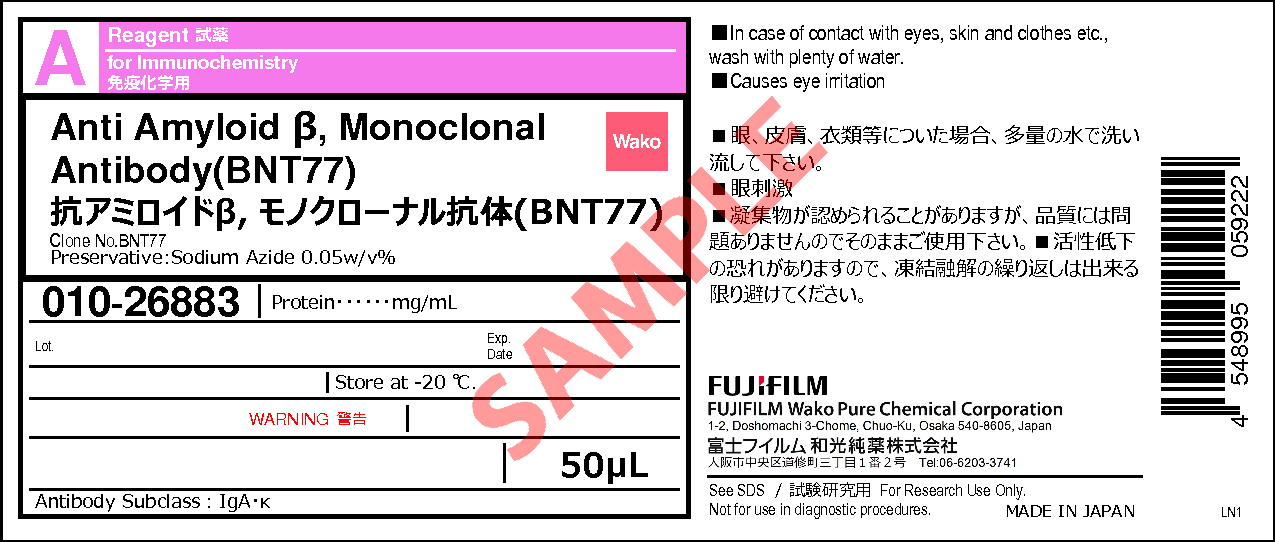
Anti Amyloid β, Monoclonal Antibody(BNT77)
- for Immunochemistry
- Manufacturer :
- FUJIFILM Wako Pure Chemical Corporation
- Storage Condition :
- Keep at -20 degrees C.
- Source :
- Human
- Cross‒Reactivity :
- Human, Mouse, Rat
- Host :
- Mouse
- Clone No. :
- BNT77
- Classification :
- Monoclonal
- Application :
- IP(1:500), IHC(1:500 - 10,000), ELISA(1:250 - 1,000)
-
 Close
Close
- Structural Formula
- Label
- Packing
|
Comparison
|
Product Number
|
Package Size
|
Price
|
Inventory
|
|
|---|---|---|---|---|---|
|
|
|
50uL
|
|
In stock in Japan |
Document
Product Overview
Amyloid β (Aβ) is a peptide of approximately 40 amino acids and is the major component of senile plaques, a pathological hallmark of Alzheimer's disease. Aβ is classified into several isoforms based on amino acid length, each differing in aggregation tendency and cytotoxicity. The amino acid sequence of Aβ also varies across animal species, and these differences are believed to influence the aggregation tendency of endogenous Aβ. It is therefore important to select an appropriate antibody based on the Aβ isoform of interest when designing experiments.
Fujifilm Wako offers anti-Aβ mouse monoclonal antibodies originally developed by Takeda Pharmaceutical Company. Thanks to their excellent specificity and reactivity, these antibodies are widely used by researchers around the world and have been featured in numerous publications. “Anti Amyloid β, Monoclonal Antibody(BNT77)” is a mouse monoclonal antibody that recognizes the central region of Aβ in humans, mice and rats. It can be used for ELISA, immunohistochemistry and immunoprecipitation.
Antibody Information
| Clonality | Monoclonal (Clone No. BNT77) |
|---|---|
| Antigen | Synthetic peptide (11-28 aa of human Aβ) |
| Host | Mouse |
| Formulation | PBS, 0.05% Sodium azide |
| Conjugate | Unconjugated |
| Cross-reactivity | Human, Mouse, Rat |
| Application | ELISA 1:250-1,000 Immunohistochemistry 1:500-10,000 Immunoprecipitation 1:500 |
Data
Immunohistochemistry
-
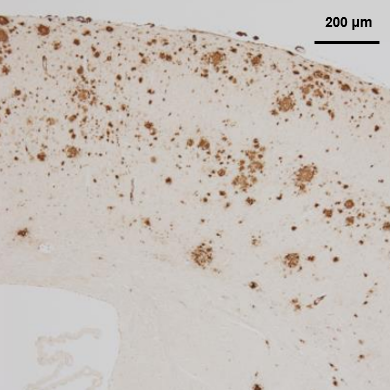 BAN50
BAN50
(Dilution 1:1,000) -
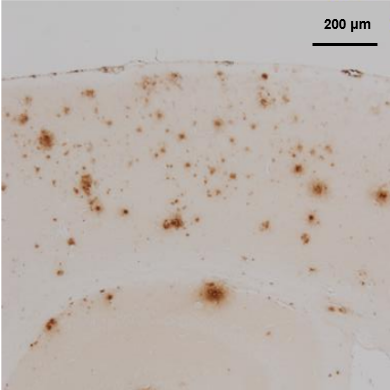 BNT77
BNT77
(Dilution 1:1,000) -
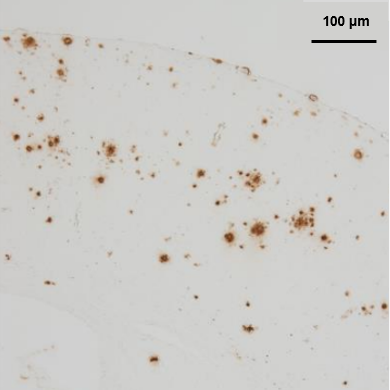 BA27
BA27
(Dilution 1:1,000) -
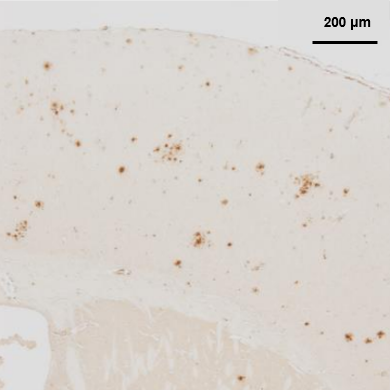 BC05
BC05
(Dilution 1:100,000)
Sample
- Species:
- 15-month-old APP/PS1 line AD model mouse, B6.Cg-Tg (APPswe, PSEN1dE9) 85Dbo/Mmjax
- Site:
- Piriform cortex
- Sample:
- Paraffin sections
Condition
- Antigen retrieval- BAN50:
- Microwave treatment in citrate buffer + proteinase K
- Detection
Biotin-conjugated antibody, Avidin-biotin system + DAB staining
Data by courtesy of Drs. Kokawa, Hashimoto and Iwatsubo, Graduate School of Medicine, University of Tokyo
FAQ
About Antibody
- What is the subclass of this antibody?
- The subclass of this antibody is IgA・κ.
- Has this antibody been affinity purified?
- Yes, it has been affinity purified using Protein A.
- What is the concentration of this antibody?
- The specification for protein concentration is 0.9-1.3 mg/mL.
Troubleshooting
- No staining is observed in immunohistochemistry of wild-type mice.
- Aβ hardly accumulates in wild-type mice. Please use mice engineered to overexpress human Aβ, etc.
Overview / Applications
| Outline | Amyloid beta(Abeta) is a peptide which consists of about 40 amino acids. Abeta is considered the cause of Alzheimer's disease, because it is a major component of senile plaques formed in brains of Alzheimer's disease patients. This item is a mouse monoclonal antibody that reacts with Abeta. [Antigen] 11-28 a.a of human Abeta [Antibody subclass]mouse IgA kappa [Applications] IP, IHC,ELISA [Reference] Asami-Odaka, A., et. al.: Biochemistry, 34, 32, 10272(1995). Tomita, T., et. al.: J. Neurosci. 19, 24, 10627(1999). Sudoh, S., et. al.: J Neurochem. 71, 4, 1535(1998). |
|---|
Property
Antibody Information
| Antigen | Amyloid β (aa11-28) |
|---|---|
| Antigen Alias | Amyloid β (aa11-28) |
| Subclass | IgA,k |
| Labeling | Unlabeled |
Manufacturer Information
Alias
- Anti-β Amyloid, Mouse Monoclonal Antibody(Clone No. BNT77)
Anti-Aβ, Mouse Monoclonal Antibody(Clone No. BNT77)
For research use or further manufacturing use only. Not for use in diagnostic procedures.
Product content may differ from the actual image due to minor specification changes etc.
If the revision of product standards and packaging standards has been made, there is a case where the actual product specifications and images are different.