



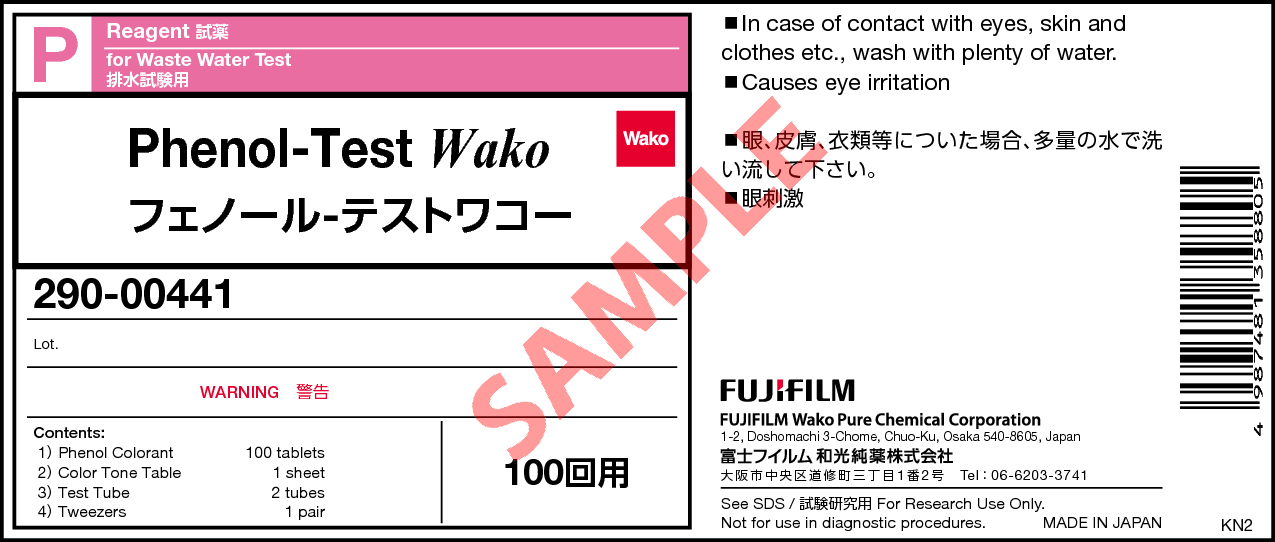
Phenol-Test wako
- for Waste Water Test
- Manufacturer :
- FUJIFILM Wako Pure Chemical Corporation
- Storage Condition :
- Keep at RT.
- GHS :
-

-
 Close
Close
- Structural Formula
- Label
- Packing
- SDS
|
Comparison
|
Product Number
|
Package Size
|
Price
|
Availability
|
Certificate of Analysis
|
Purchase |
|---|---|---|---|---|---|---|
|
|
|
100Tests
|
|
In stock in Japan |
※Check availability in the US with the distributor.
Document
Application
Overview / Applications
| Outline | 4-Aminoantipyrine method is excellent for the measurement of phenols and has been adopted as a testing method for industrial wastewater, JIS K 0102-1971.Phenol-Test Wako is a kit designed for quick and accurate measurement of phenols with simple operation by the 4-aminoantipyrine method.1. Very Simple and High SensitivePhenols as little as 1 ppm can be detected.2. Wide range of usage.PrincipleWhen 1 tablet of Phenol Colorant is dissolved in 10 mL of test water, the pH of the test sample exhibits weak alkaline (pH 7-10). Traces of phenols (1-10ppm) react to the 4-aminoantipyrine and potassium ferricyanide contained in Phenol Colorant to form a red dye.The amount of phenols (ppm) is determined by the tone of the red color.In addition to phenols, which an OH group is attached to benzene or polycyclic compounds, phenol derivatives whose substituents are in ortho- or meta- position to OH group develop similar colors by this assay. Therefore, phenols measured by this assay are all expressed in terms of the amount of phenol (C6H5OH) with the same concentrations as those of the produced dye.Since para-coordinated phenol derivatives have generally low reactivity with 4-aminoantipyrine, use an alternative method (testing method for industrial wastewater, JIS K 0102-1971) for detection of these compounds. This product is for research use only. Do not administer it to human. 4-Aminoantipyrine Method The kit contents (for 100 tests)
Assay Procedure:
|
|---|
Property
Manufacturer Information
Alias
For research use or further manufacturing use only. Not for use in diagnostic procedures.
Product content may differ from the actual image due to minor specification changes etc.
If the revision of product standards and packaging standards has been made, there is a case where the actual product specifications and images are different.