



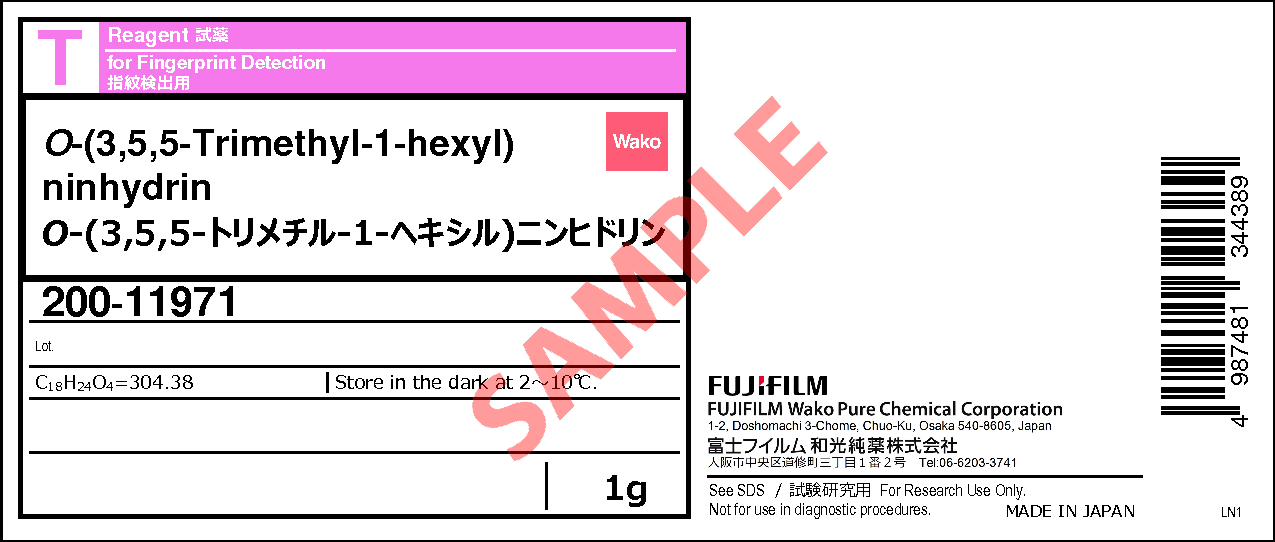
O-(3,5,5-Trimethyl-1-hexyl)ninhydrin
- for Fingerprint Detection
- Specification Assay :
- 98.0+% (HPLC)
- Manufacturer :
- FUJIFILM Wako Pure Chemical Corporation
- Storage Condition :
- Keep at 2-10 degrees C. (RT)
- Molecular Formula :
- C18H24O4
- Molecular Weight :
- 304.38
-
 Close
Close
- Structural Formula
- Label
- Packing
- SDS
|
Comparison
|
Product Number
|
Package Size
|
Price
|
Availability
|
Certificate of Analysis
|
Purchase |
|---|---|---|---|---|---|---|
|
|
|
1G
|
|
Out of Stock |
||
|
|
|
10g
|
|
Discontinued
|
|
|
|
|
|
50g
|
|
Discontinued
|
※Check availability in the US with the distributor.
Document
Overview / Applications
| Outline | This product is for research use only. Do not administer it to human. This reagent is O-alkyl derivative of ninhydrin developed by Masahisa Takatsu and coresearchers at Scientific Crime Lab., Identification Section, Hyogo Pref. Police H.Q. Latent fingerprints on some kinds of thermal paper such as train tickets can be detected with this reagent. Current method to detect the latent fingerprints on papers is to use ninhydrin reagent. However, when applied on thermal papers which are widely used, it does not give a clear picture of fingerprints due to a dark background of the thermal paper caused by polar solvents such as acetone or alcohol used to dissolve the reagent. The new fingerprint detection reagent developed by the lab has the ability to detect clearly the latent fingerprints without damaging the thermal paper. Detection of latent fingerprints on a thermal paper and a thermal ticket. A Method: Dip & Dry method with Ninhydrin solution of 0.5% petroether-ethanol (97:3) B Method: Sandwich method with Japanese paper swelled with Ninhydrin solution C Method: Dip & Dry method with 0.4% hexane solution of this reagent. |
|---|
Property
| Appearance | White - pale yellow, crystals - crystalline powder or mass |
|---|
Manufacturer Information
Alias
- NON Reagent
For research use or further manufacturing use only. Not for use in diagnostic procedures.
Product content may differ from the actual image due to minor specification changes etc.
If the revision of product standards and packaging standards has been made, there is a case where the actual product specifications and images are different.