



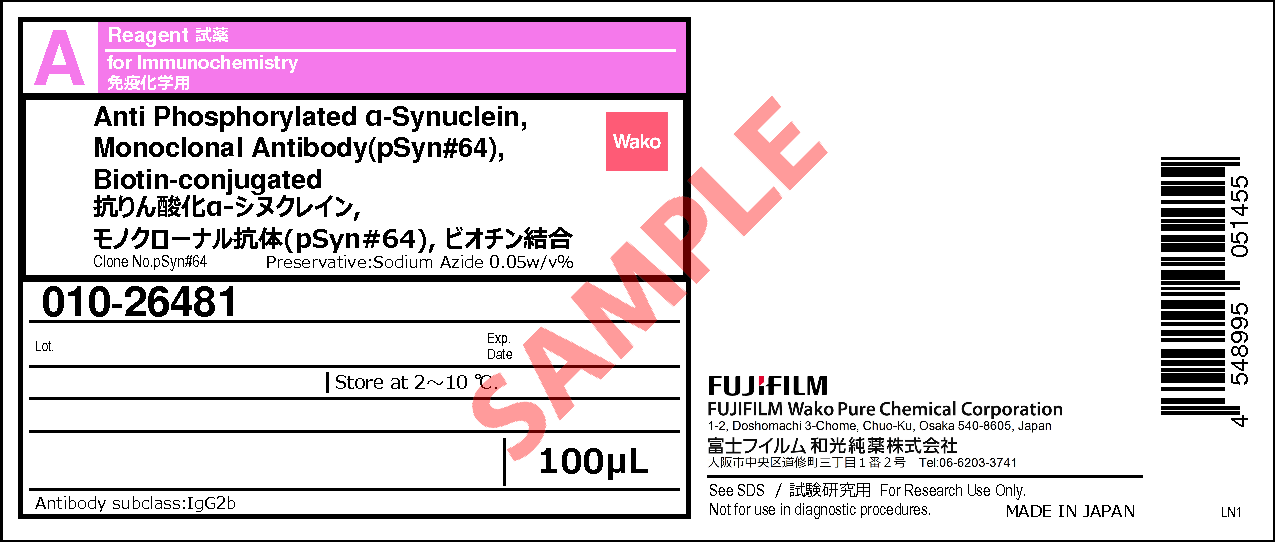
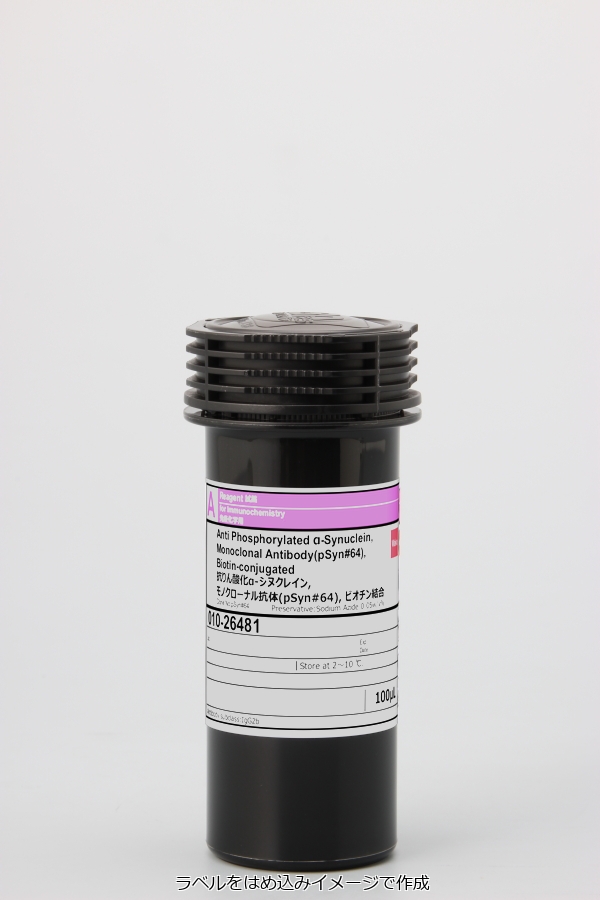
Anti Phosphorylated α-Synuclein, Monoclonal Antibody(pSyn#64), Biotin-conjugated
- for Immunochemistry
- Manufacturer :
- FUJIFILM Wako Pure Chemical Corporation
- Storage Condition :
- Keep at 2-10 degrees C.
- Source :
- Human
- Host :
- Mouse
- Clone No. :
- pSyn#64
- Classification :
- Monoclonal
-
 Close
Close -
 Close
Close
- Structural Formula
- Label
- Packing
|
Comparison
|
Product Number
|
Package Size
|
Price
|
Inventory
|
|
|---|---|---|---|---|---|
|
|
|
100uL
|
|
In stock in Japan |
Document
Product Overview
Diseases characterized by the accumulation of α-synuclein are called "synucleinopathies," and examples include Parkinson's disease, dementia with Lewy bodies, and multiple system atrophy. α-Synuclein found in Lewy bodies of patients with Parkinson’s disease and dementia with Lewy bodies is known to be phosphorylated at Ser129.
“Anti Phosphorylated α-Synuclein, Monoclonal Antibody(pSyn#64), Biotin-conjugated“ is a biotin-conjugated “Anti Phosphorylated α-Synuclein, Monoclonal Antibody (pSyn#64)” (Product No. 015-25191). It enables sensitive detection of Ser129-phosphorylated α-synuclein with low background using techniques such as the avidin-biotin complex (ABC) method in combination with peroxidase-conjugated streptavidin.
Antibody Information
| Clonality | Monoclonal (Clone No. pSyn#64) |
|---|---|
| Antigen | Human α-synuclein (residues 124–134) phosphorylated at Ser129 |
| Host | Mouse |
| Formulation | D-PBS, 0.05% Sodium azide |
| Conjugate | Biotin-conjugated |
| Cross-reactivity | Human, Mouse, Rat (α-synuclein phosphorylated at Ser129) |
| Application | Immunocytochemistry 1:200-5,000 Immunohistochemistry 1:200-5,000 |
Data
Application Data
Immunohistochemistry
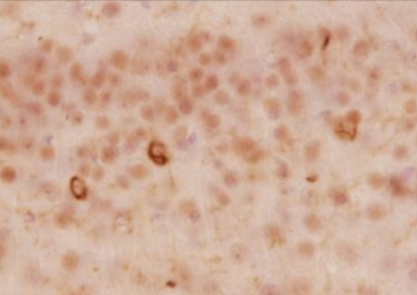
(pSyn#64)
+
Biotin-conjugated secondary antibody
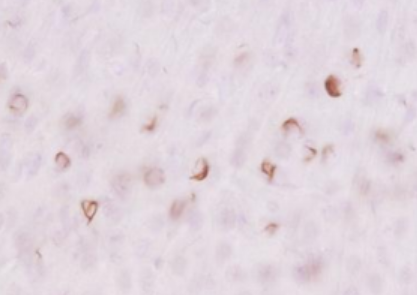
+
ABC method
- Species:
- Mouse (6 months old, wild-type, injected intracerebrally with aggregated α-synuclein)
- Site:
- Striate
- Sample:
- Vibratome section (50 μm thick)
- Antibody concentration:
- 1:1,000
- Staining:
- DAB staining
Data by courtesy of
Drs. Kuwahara and Iwatsubo, Graduate School of Medicine, The University of Tokyo
[Result]
By combining the biotin-labeled antibody with the ABC method, background staining was reduced compared with detection using a secondary antibody, resulting in clearer, more distinct staining.
FAQ
About Antibody
- What is the subclass of this antibody?
- The subclass of this antibody is IgG2b.
Troubleshooting
- Immunohistochemistry does not produce detectable staining in wild-type mice.
- Virtually no phosphorylated α-synuclein accumulates in wild-type mice; therefore, immunohistochemistry does not yield detectable staining.
Overview / Applications
| Outline | This product is for research use only. Do not administer it to human.alpha;-Synuclein in Lewy bodies (LBs), which are pathognomonic for Parkinson's disease (PD) and dementia with Lewy bodies (DLB), is phosphorylated at Ser129. We launched an antibody which specifically reacts with alpha-synuclein phosphorylated at Ser 129 and does not react with non-phosphrylated alpha-synuclein. Secondary antibody is not necessary because it is already biotin-labeled. Clone No. ; pSyn#64 Antigen: Peptide (residues 124-134) including phosphorylated Ser129 of human alpha-Synuclein Isotype:Mouse IgG2b Reactivity:reacts with human and rodent alpha-synuclein including phospholated S129. Not reaction to wild-type mice, rats or healthy person. We are not able to guarantee that this item is applicable to any patients or model animals Applications: Immunohistochemistry 1:200-5,000 immunocytochemistry 1:200-5,000. |
|---|
Property
| Appearance | Liquid |
|---|
Antibody Information
| Antigen | α-Synuclein (Phosphorylated Ser129,residues124-134) |
|---|---|
| Antigen Alias | α-Synuclein (Phosphorylated Ser129,residues124-134) |
| Labeling | Biotin |
Manufacturer Information
Alias
- Anti SNCA pS129, Mouse Monoclonal Antibody(pSyn#64), Biotin-labeled
For research use or further manufacturing use only. Not for use in diagnostic procedures.
Product content may differ from the actual image due to minor specification changes etc.
If the revision of product standards and packaging standards has been made, there is a case where the actual product specifications and images are different.