



Anti Phosphorylated α-Synuclein, Monoclonal Antibody (pSyn#64)
- for Immunochemistry
- Manufacturer :
- FUJIFILM Wako Pure Chemical Corporation
- Storage Condition :
- Keep at -20 degrees C.
- Clone No. :
- pSyn #64
- Classification :
- Monoclonal
-
 Close
Close
- Structural Formula
- Label
- Packing
|
Comparison
|
Product Number
|
Package Size
|
Price
|
Inventory
|
|
|---|---|---|---|---|---|
|
|
|
50uL
|
|
In stock in Japan |
Document
Product Overview
Diseases characterized by the accumulation of α-synuclein are called "synucleinopathies," and examples include Parkinson's disease, dementia with Lewy bodies, and multiple system atrophy. α-Synuclein found in Lewy bodies of patients with Parkinson’s disease and dementia with Lewy bodies is known to be phosphorylated at Ser129.
“Anti Phosphorylated α-Synuclein, Monoclonal Antibody (pSyn#64)“ is a mouse monoclonal antibody that specifically reacts with Ser129-phosphorylated α-synuclein. This product does not react with unphosphorylated α-synuclein and selectively recognizes only accumulated Ser129-phosphorylated α-synuclein. Accordingly, it is suitable for visualizing Lewy bodies by immunohistochemistry and for detecting Ser129-phosphorylated α-synuclein by Western blotting.
Antibody Information
| Clonality | Monoclonal (Clone No. pSyn#64) |
|---|---|
| Antigen | Human α-synuclein (residues 124–134) phosphorylated at Ser129 |
| Host | Mouse |
| Formulation | Serum-free medium, 0.05% Sodium azide |
| Conjugate | Unconjugated |
| Cross-reactivity | Human, Mouse, Rat (α-synuclein phosphorylated at Ser129) |
| Application | Immunohistochemistry 1:1,000-10,000 Western blotting 1:1,000-10,000 |
Data
Application Data
Immunohistochemistry
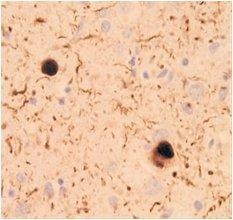
Species: Human (Dementia with Lewy bodies)
Site: Brain
Data by courtesy of
Dr. Iwatsubo, Graduate School of Medicine, The University of Tokyo
Detection of Ser129-phosphorylated α-synuclein in skin biopsy specimens from patients with synucleinopathies
Gibbons et al. (JAMA, 331(15), 1298 (2024))1) investigated whether synucleinopathies—such as Parkinson’s disease, multiple system atrophy, and dementia with Lewy bodies—could be detected by analyzing α-synuclein in skin biopsy specimens using Fujifilm Wako’s Anti Phosphorylated α-Synuclein, Monoclonal Antibody (pSyn#64).
| Diagnosis | P-SYN positive*1 | P-SYN negative*2 | Proportion of participants positive for P-SYN (95% CI) |
|
|---|---|---|---|---|
| Synucleinopathies | 213 | 10 | 95.5% (91.9-97.8%) | |
| Parkinson’s disease | 89 | 7 | 92.7% (85.6-97.0%) | |
| Multiple system atrophy | 54 | 1 | 98.2% (91.7-99.9%) | |
| Dementia with Lewy bodies | 48 | 2 | 96.0% (86.3-99.5%) | |
| Pure autonomic failure | 22 | 0 | 100% (84.6-100%) | |
| No synucleinopathies | 4 | 116 | 3.3% (1.3-8.0%) | |
*2 Negative for P-SYN in all biopsy sites.
[Result]
The proportion of skin biopsy specimens positive for Ser129-phosphorylated α-synuclein was 92.7% in Parkinson’s disease, 98.2% in multiple system atrophy, 96.0% in dementia with Lewy bodies, and 100% in pure autonomic failure, whereas only 3.3% of individuals without a history of synucleinopathy (control group) tested positive (Table 1).
References
- Gibbons, C. H. et al.: JAMA, 331(15), 1298(2024).
Skin Biopsy Detection of Phosphorylated α-Synuclein in Patients With Synucleinopathies
FAQ
About Antibody
- What is the subclass of this antibody?
- The subclass of this antibody is IgG2b.
About Protocol
- What solubilizing agent should be used for phosphorylated α-synuclein in Western blotting?
- Use 8 M urea. Triton X-100 and sarkosyl do not effectively solubilize the insoluble α-synuclein composed of phosphorylated α-synuclein, so it cannot be detected if either of these reagents is used.
- Can this antibody be used for immunochemistry on tissues fixed in 4% paraformaldehyde (PFA)?
- Fujifilm Wako has not verified this, but the following publication reports its use with PFA-fixed tissues:
Troubleshooting
- Immunohistochemistry does not produce detectable staining in wild-type mice.
- Virtually no phosphorylated α-synuclein accumulates in wild-type mice; therefore, immunohistochemistry does not yield detectable staining.
Overview / Applications
| Outline | This product is for research use only. Do not administer it to human. alpha-synuclein in Lewy bodies (LBs), which are pathognomonic for Parkinson's disease (PD) and dementia with Lewy bodies (DLB), is phosphorylated at Ser 129. We launched an antibody which specifically reacts with alpha-synuclein phosphorylated at Ser 129 and does not react with non-phosphrylated alpha-synuclein. This antibody is applicable to immunohistochemical and biological studies related to Parkinson's disease and LB pathology.Not reaction to wildtype mice, rats or healthy person.We are not able to guarantee that this item is applicable to any patients or model animals. [Clone No.] pSyn#64 [Antibody Subclass] Mouse IgG [Applications] WB(1:1,000-1:10,000) IHC(1:1,000-1:10,000) [Example of IHC protocol] See insert [References] 1. Fujiwara, H., et al.: Nature Cell Biology, 4, 160 (2002). 2. Saito, Y., et al.: Neuropathol Exp Neurol, 62, 644 (2003). 3. Hirai, Y., et al.: FEBS Letters, 572, 227-232 (2004). |
|---|
Property
| Appearance | Liquid |
|---|
Antibody Information
| Antigen | Phosphorylated α-Synuclein |
|---|---|
| Antigen Alias | Phosphorylated α-Synuclein |
| Subclass | IgG |
Manufacturer Information
Alias
For research use or further manufacturing use only. Not for use in diagnostic procedures.
Product content may differ from the actual image due to minor specification changes etc.
If the revision of product standards and packaging standards has been made, there is a case where the actual product specifications and images are different.