



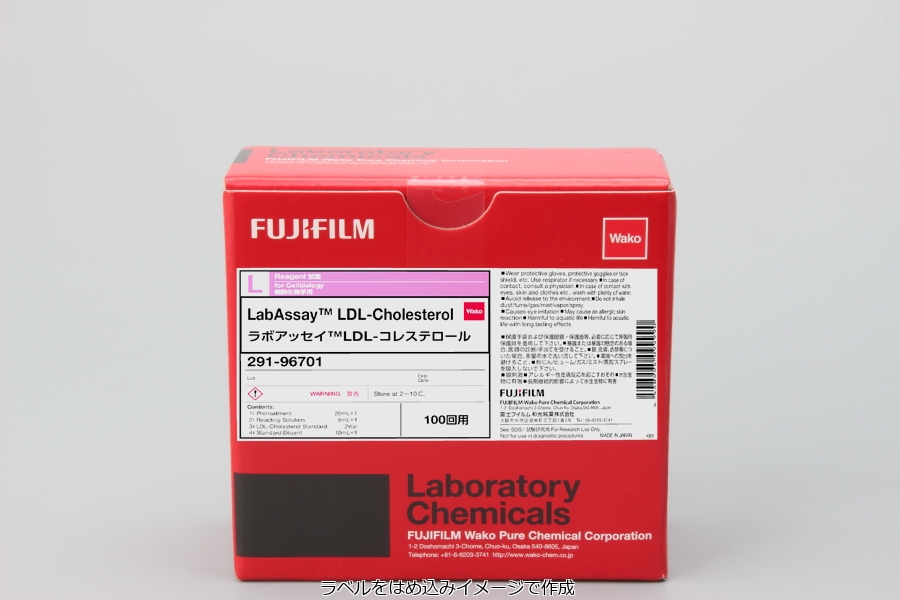
LabAssay™ LDL-Cholesterol
- for Cellbiology
- Manufacturer :
- FUJIFILM Wako Pure Chemical Corporation
- Storage Condition :
- Keep at 2-10 degrees C.
- GHS :
-


-
 Close
Close -
 Close
Close
- Structural Formula
- Label
- Packing
- SDS
|
Comparison
|
Product Number
|
Package Size
|
Price
|
Inventory
|
|
|---|---|---|---|---|---|
|
|
|
100Tests
|
|
In stock in Japan |
Please check here for notes on products and prices.
Document
Kit component
For 100 tests
| Pretreatment | 20 mL/1 bottle |
|---|---|
| Reacting Solution | 8 mL/1 bottle |
| LDL-Cholesterol Standard | 2 bottles |
| Standard Diluent | 10 mL/1 bottle |
Product Overview
The cholesterol carried by Low Density Lipoprotein (LDL) termed LDL-cholesterol. LDL carries cholesterol produced in the liver throughout the body, and when present in large amounts in the blood, it deposits and accumulates in blood vessel walls, causing atherosclerosis and resulting in myocardial infarction and cerebral infarction.
In humans, the normal range of LDL-cholesterol is less than 140 mg/dL, and more than 140 mg/dL is considered to reflect hyper-LDL cholesterolemia.
LabAssay™ LDL-Cholesterol is a kit designed to measure LDL-cholesterol samples. With the use of a microplate, this kit provides a quick and convenient method for measuring LDL-cholesterol in samples. In addition, our kit do not require fractionation of lipoproteins by centrifugation.
Kit Performance
| Analysis sample | Human Serum/Plasma Mouse Serum/Plasma Rat Serum/Plasma |
|---|---|
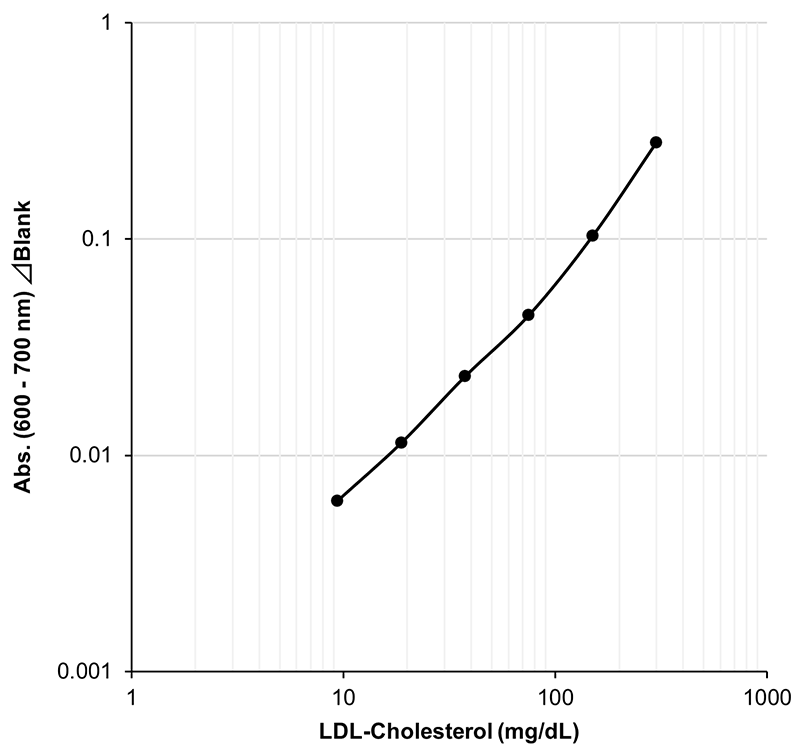
| Calibration curve range | 9.38-300 mg/dL |
| Sample volume | 5 μL |
| Measurement duration | Approx. 20 min |
| Wavelength | Primary wavelength 600 nm Reference wavelength 700 nm |
Example of Calibration Curve
Assay Principle
1) The first reaction(elimination of non-LDL cholesterol)
The block polymer containing hydrophilic and hydrophobic moiety in Pretreatment selectively binds to LDL in the specimens, and protects it from enzyme (CHE, CO) reactions. CHE and CO react with non-LDL lipoprotein [chylomicron (CM), very low density lipoprotein (VLDL), high density lipoprotein (HDL)]. Hydrogen peroxide produced by the enzyme reactions with non-LDL cholesterol is decomposed to water by catalase in Pretreatment reagent.

2) The second reaction(color reaction of LDL-cholesterol)
When Reacting Solution is added, the cholesterol and its derivatives in LDL produce hydrogen peroxide by CHE and CO. Hydrogen peroxide produced by the enzyme reactions with LDL-cholesterol yields a blue color pigment upon oxidative condensation with N-(3-sulfopropyl)-3-methoxy-5-methylaniline (HMMPS) and 4-aminoantipyrine in the presence of peroxidase (POD). The amount of LDL-cholesterol contained in the sample is determined by measuring the absorbance of the blue color.

Data
Repeatability (within run precision)
Repeatability was conducted by measuring five-fold assays of samples from human, mouse and rat at two concentrations with this product.
| n\ID | Human sample | Mouse sample | Rat sample | |||
|---|---|---|---|---|---|---|
| ID1 (mg/dL) | ID2 (mg/dL) | ID1 (mg/dL) | ID2 (mg/dL) | ID1 (mg/dL) | ID2 (mg/dL) | |
| 1 | 160 | 46.0 | 141 | 48.3 | 119 | 33.3 |
| 2 | 156 | 43.8 | 138 | 47.9 | 114 | 34.1 |
| 3 | 158 | 44.7 | 138 | 49.5 | 119 | 33.3 |
| 4 | 166 | 44.5 | 139 | 48.5 | 112 | 34.9 |
| 5 | 159 | 45.7 | 136 | 50.6 | 113 | 33.3 |
| mean | 160 | 44.9 | 138 | 49.0 | 115 | 33.8 |
| SD | 3.77 | 0.902 | 1.82 | 1.09 | 3.36 | 0.716 |
| CV(%) | 2.4 | 2.0 | 1.3 | 2.2 | 2.9 | 2.1 |
[Result]
The CV (%) of human sample was 2.0-2.4%, mouse sample was 1.3-2.2%, and rat sample was 2.1-2.9%, indicating good repeatability.
Reproducibility (between run precision)
Reproducibility was conducted by measuring samples from human, mouse, rat at three concentrations each for four days with this product.
| Day\ID | Human sample | Mouse sample | Rat sample | ||||||
|---|---|---|---|---|---|---|---|---|---|
| ID3 (mg/dL) | ID4 (mg/dL) | ID5 (mg/dL) | ID3 (mg/dL) | ID4 (mg/dL) | ID5 (mg/dL) | ID3 (mg/dL) | ID4 (mg/dL) | ID5 (mg/dL) | |
| 1 | 125 | 88.1 | 41.8 | 119 | 91.4 | 48.4 | 130 | 78.7 | 45.2 |
| 2 | 124 | 87.0 | 41.1 | 119 | 88.1 | 45.0 | 129 | 76.1 | 42.9 |
| 3 | 130 | 91.5 | 41.7 | 118 | 88.0 | 48.2 | 126 | 74.2 | 49.7 |
| 4 | 125 | 89.5 | 39.8 | 126 | 95.1 | 50.4 | 131 | 74.5 | 49.4 |
| mean | 126 | 89.0 | 41.1 | 121 | 90.6 | 48.0 | 129 | 75.9 | 46.8 |
| SD | 2.71 | 1.94 | 0.920 | 3.70 | 3.36 | 2.23 | 2.16 | 2.06 | 3.31 |
| CV(%) | 2.1 | 2.2 | 2.2 | 3.1 | 3.7 | 4.7 | 1.7 | 2.7 | 7.1 |
[Result]
The CV (%) of human sample was 2.1-2.2%, mouse sample was 3.1-4.7%, and rat sample was 1.7-7.1%, indicating good reproducibility.
Dilution Linearity Test
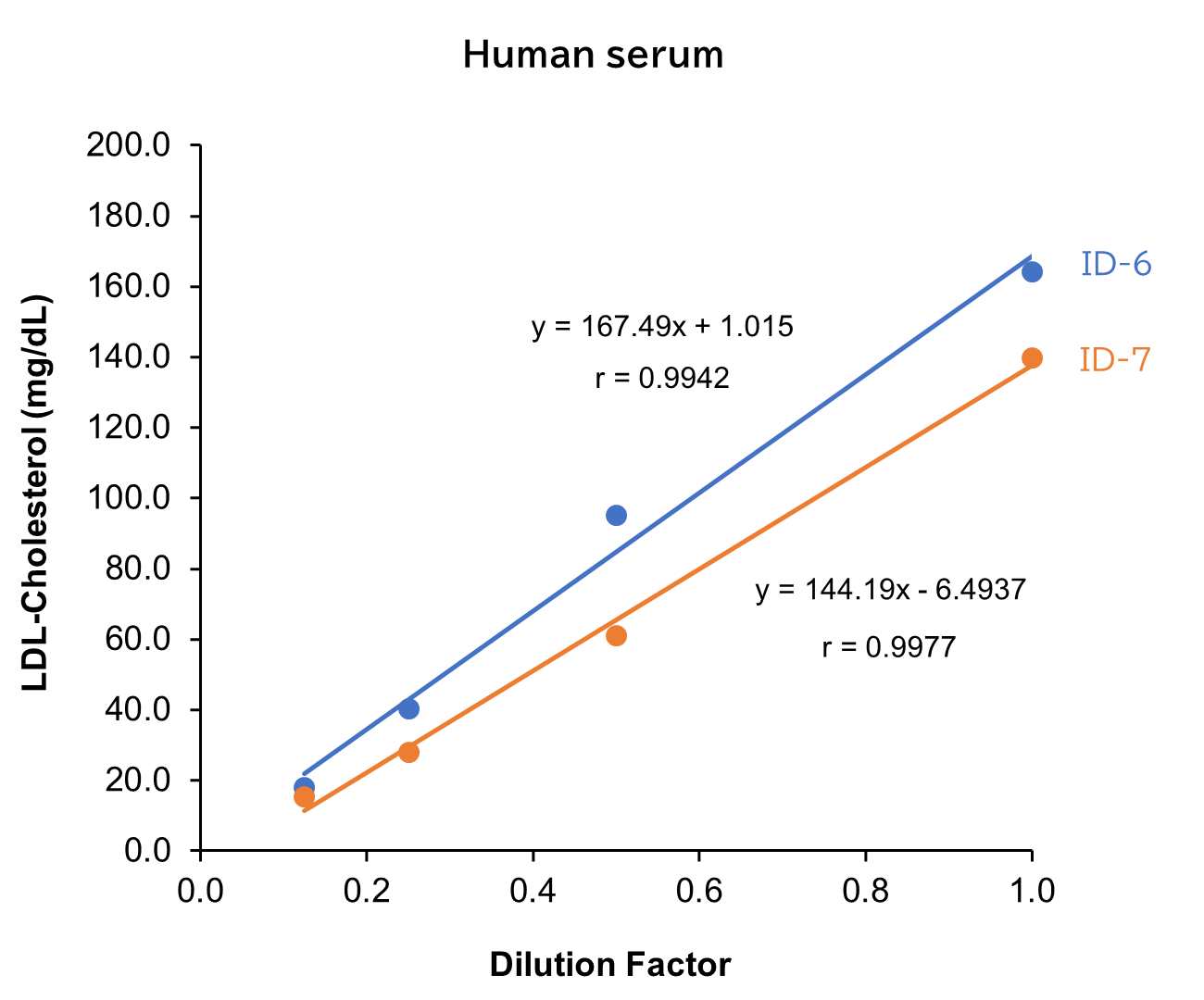
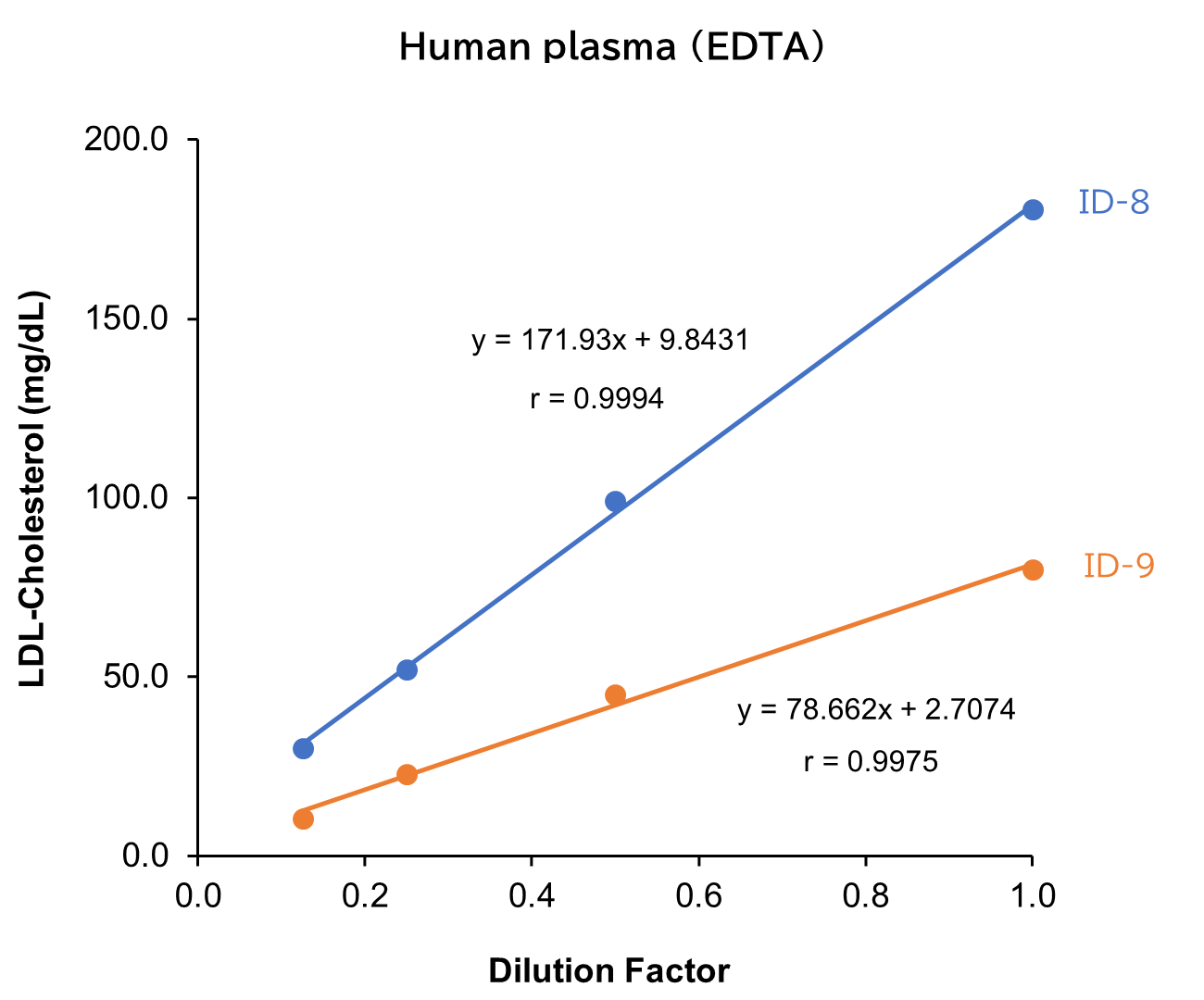
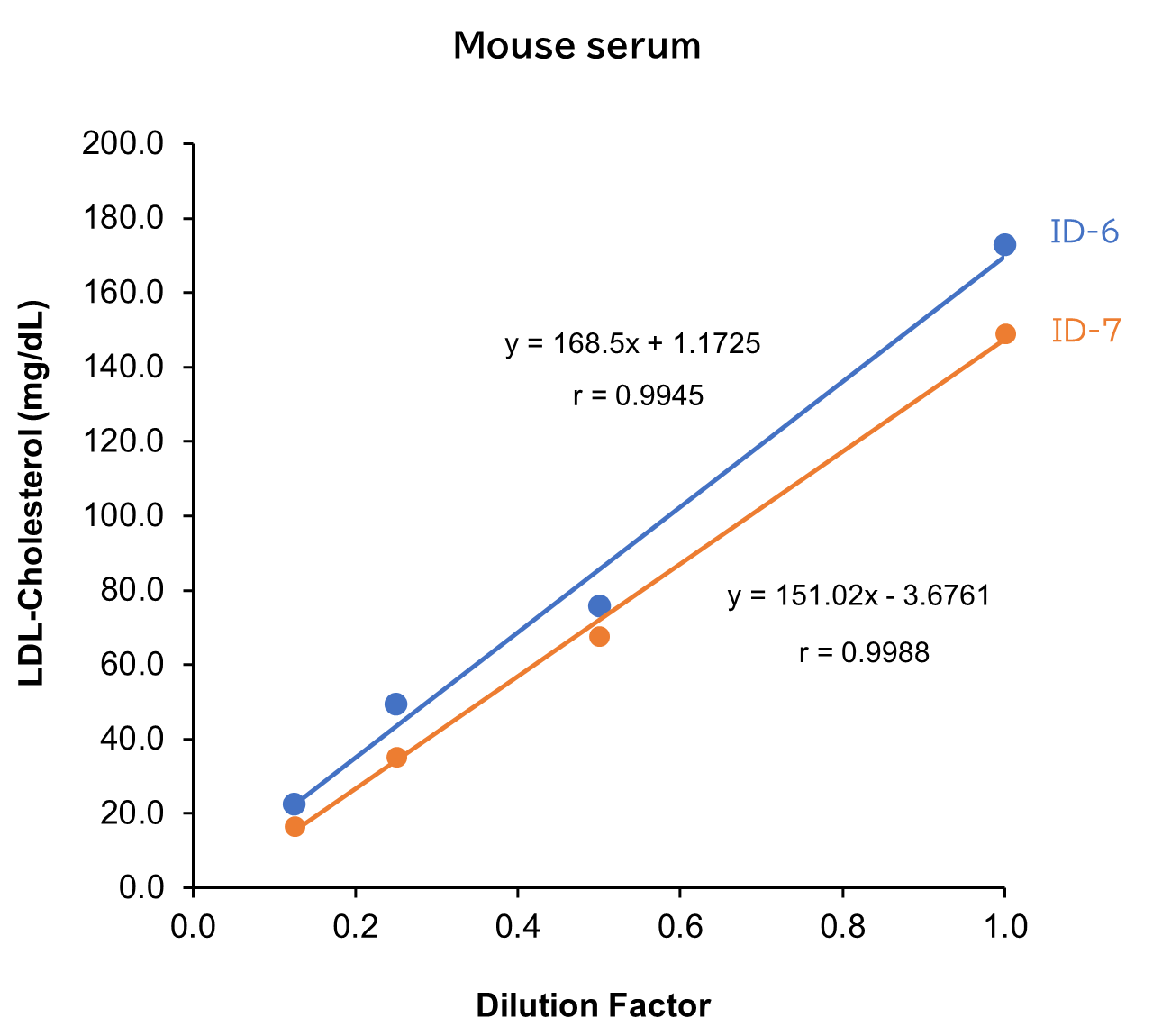
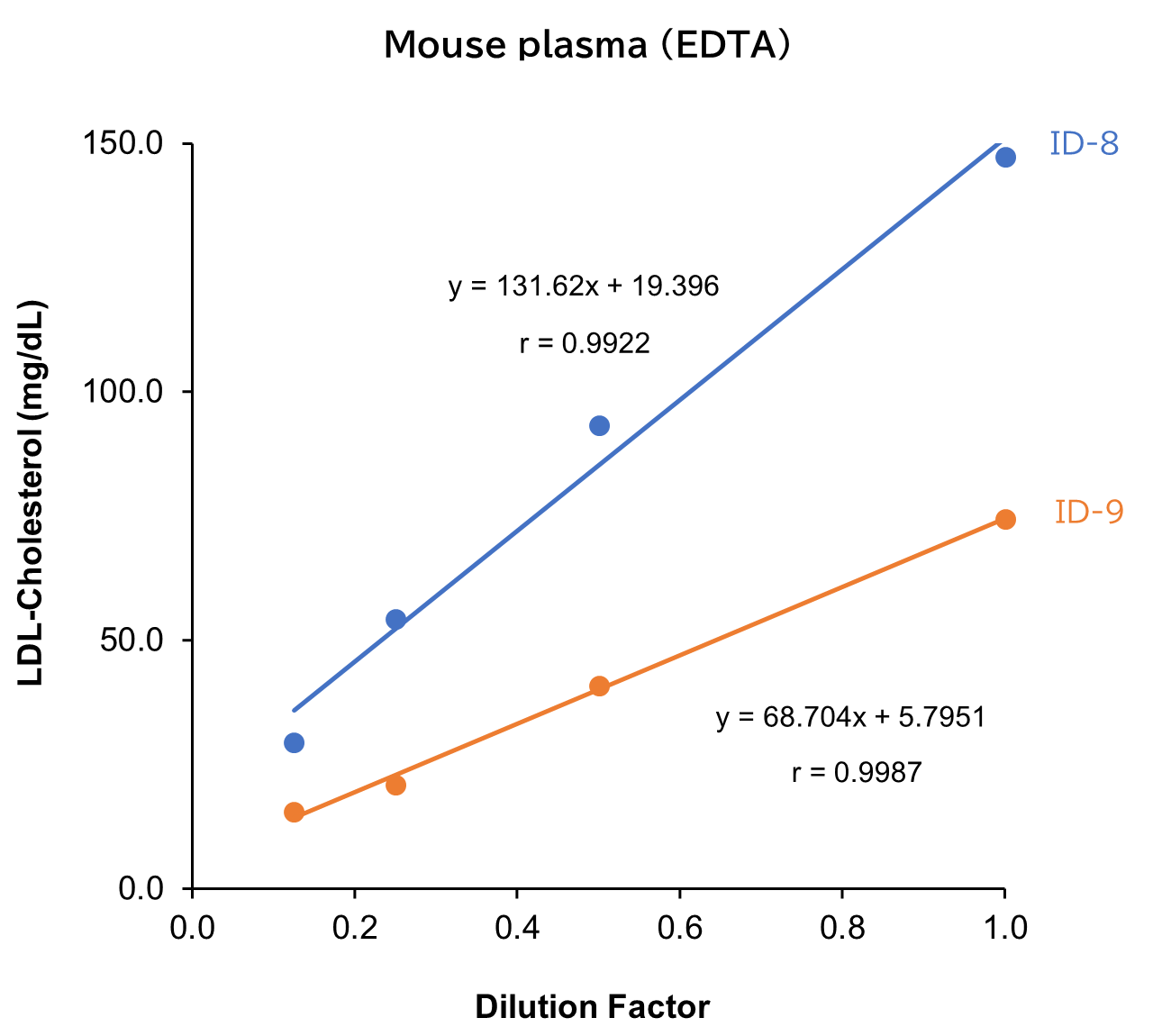
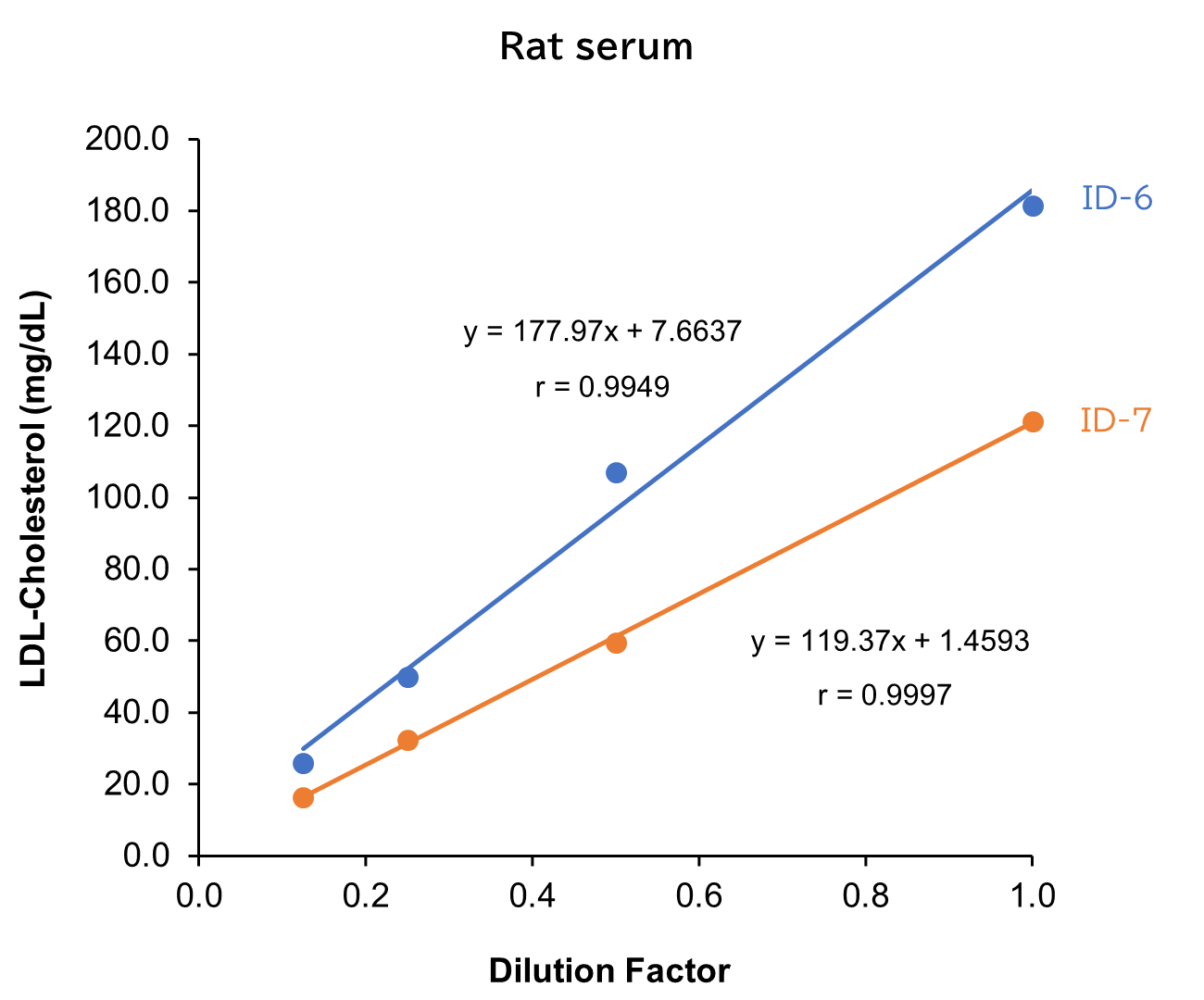
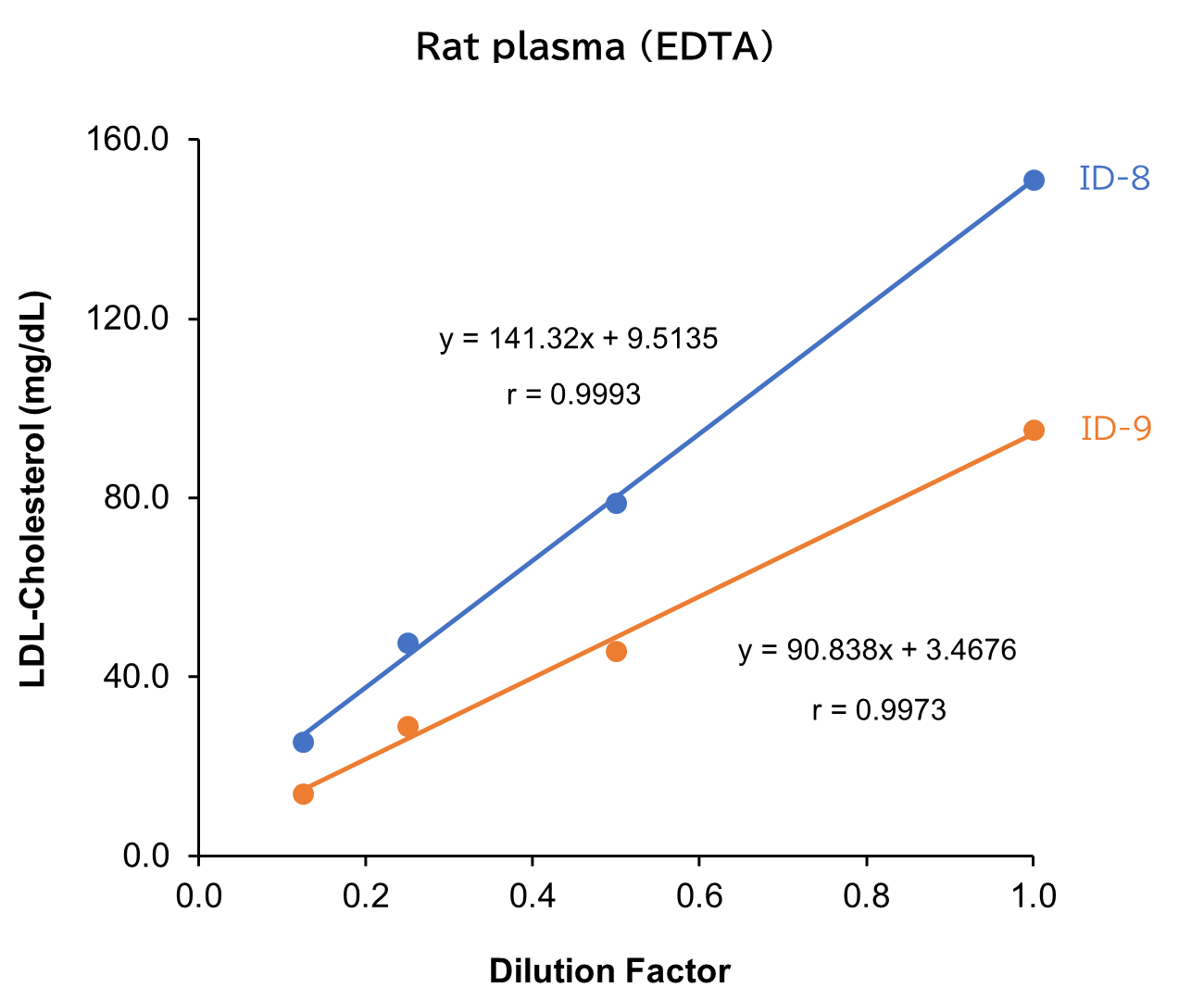
Serum and plasma (EDTA) from human, mouse and rat spiked with the standard, were serially diluted twofold with buffer in this kit and measured in duplicate to assess linearity.
[Result]
All measurement results showed good linearity within the measurement range
Spike and Recovery Test
Standard solutions at three concentrations were added to serum/plasma (EDTA) from human, mouse and rat. Next, spike recovery tests were conducted, with each measurement performed in duplicate.
Human sample
| Spiked amount (mg/dL) |
Measurement value (mg/dL) |
Recovery volume (mg/dL) |
Recovery rate (%) |
|
|---|---|---|---|---|
| Serum | - | 75.2 | - | - |
| 7.12 | 82.3 | 7.10 | 99.7 | |
| 28.5 | 103 | 27.8 | 97.5 | |
| 35.6 | 112 | 36.8 | 103 | |
| Average | 100 | |||
| Plasma (EDTA) |
- | 84.5 | - | - |
| 10.6 | 93.8 | 9.30 | 87.7 | |
| 21.2 | 107 | 22.5 | 106 | |
| 26.5 | 112 | 27.5 | 104 | |
| Average | 99.2 | |||
Mouse sample
| Spiked amount (mg/dL) |
Measurement value (mg/dL) |
Recovery volume (mg/dL) |
Recovery rate (%) |
|
|---|---|---|---|---|
| Serum | - | 86.6 | - | - |
| 15.9 | 102 | 15.4 | 96.9 | |
| 23.8 | 112.0 | 25.4 | 107 | |
| 39.7 | 126 | 39.4 | 99.2 | |
| Average | 101 | |||
| Plasma (EDTA) |
- | 97.7 | - | - |
| 14.4 | 112 | 14.3 | 99.3 | |
| 28.9 | 126 | 28.3 | 97.9 | |
| 36.1 | 133 | 35.3 | 97.8 | |
| Average | 98.3 | |||
Rat sample
| Spiked amount (mg/dL) |
Measurement value (mg/dL) |
Recovery volume (mg/dL) |
Recovery rate (%) |
|
|---|---|---|---|---|
| Serum | - | 14.6 | - | - |
| 13.7 | 28.7 | 14.1 | 103 | |
| 41.0 | 53.0 | 38.4 | 93.7 | |
| 68.4 | 77.1 | 62.5 | 91.4 | |
| Average | 96.0 | |||
| Plasma (EDTA) |
- | 16.2 | - | - |
| 16.0 | 31.9 | 15.7 | 98.1 | |
| 48.1 | 64.4 | 48.2 | 100 | |
| 80.2 | 90.6 | 74.4 | 92.8 | |
| Average | 97.0 | |||
[Result]
Good recovery rates were confirmed.
Measurement Using Actual Samples
Human sample
| ID\n | Measurement value (mg/dL) | mean | SD | CV (%) |
||
|---|---|---|---|---|---|---|
| 1 | 2 | |||||
| Serum | ID1 | 189 | 187 | 188 | 1.41 | 0.8 |
| ID2 | 88.8 | 93.2 | 91.0 | 3.11 | 3.4 | |
| ID3 | 85.7 | 85.7 | 85.7 | 0.00 | 0.0 | |
| ID4 | 99.0 | 93.9 | 96.5 | 3.61 | 3.7 | |
| ID5 | 95.8 | 94.0 | 94.9 | 1.27 | 1.3 | |
| Plasma (EDTA) |
ID1 | 122 | 121 | 122 | 0.707 | 0.6 |
| ID2 | 88.3 | 88.0 | 88.2 | 0.212 | 0.2 | |
| ID3 | 85.9 | 84.4 | 85.2 | 1.06 | 1.2 | |
| ID4 | 93.9 | 97.2 | 95.6 | 2.33 | 2.4 | |
| ID5 | 95.1 | 95.4 | 95.3 | 0.212 | 0.2 | |
Mouse sample (CD-1(ICR))
| ID\n | Measurement value (mg/dL) | mean | SD | CV (%) |
||
|---|---|---|---|---|---|---|
| 1 | 2 | |||||
| Serum | ID1 | 32.6 | 33.4 | 33.0 | 0.566 | 1.7 |
| ID2 | 33.6 | 31.3 | 32.5 | 1.63 | 5.0 | |
| ID3 | 33.4 | 32.4 | 32.9 | 0.707 | 2.1 | |
| ID4 | 34.5 | 33.4 | 34.0 | 0.778 | 2.3 | |
| ID5 | 36.1 | 34.1 | 35.1 | 1.41 | 4.0 | |
| Plasma (EDTA) |
ID1 | 21.2 | 20.8 | 21.0 | 0.283 | 1.3 |
| ID2 | 16.0 | 17.7 | 16.9 | 1.20 | 7.1 | |
| ID3 | 25.5 | 21.2 | 23.4 | 3.04 | 13.0 | |
| ID4 | 19.1 | 20.3 | 19.7 | 0.849 | 4.3 | |
| ID5 | 18.9 | 19.6 | 19.3 | 0.495 | 2.6 | |
Rat sample (S.D. rat)
| ID\n | Measurement value (mg/dL) | mean | SD | CV (%) |
||
|---|---|---|---|---|---|---|
| 1 | 2 | |||||
| Serum | ID1 | 43.3 | 37.9 | 40.6 | 3.82 | 9.4 |
| ID2 | 44.4 | 42.3 | 43.4 | 1.48 | 3.4 | |
| ID3 | 42.7 | 44.0 | 43.4 | 0.919 | 2.1 | |
| ID4 | 44.9 | 43.2 | 44.1 | 1.20 | 2.7 | |
| ID5 | 50.0 | 51.1 | 50.6 | 0.778 | 1.5 | |
| Plasma (EDTA) |
ID1 | 30.7 | 30.1 | 30.4 | 0.424 | 1.4 |
| ID2 | 33.7 | 32.8 | 33.3 | 0.636 | 1.9 | |
| ID3 | 39.2 | 36.5 | 37.9 | 1.91 | 5.0 | |
| ID4 | 30.7 | 30.9 | 30.8 | 0.141 | 0.5 | |
| ID5 | 33.9 | 36.7 | 35.3 | 1.98 | 5.6 | |
FAQ
About sample
- What specimens should I use?
- Use fresh specimens. Do not use specimens after repeated freeze-thawing as this may denature lipoproteins.
- Which anticoagulants can I use?
- Anticoagulants such as heparin, citrate and EDTA do not significantly influence the assay when used in normal amounts.
- What should I do with samples that exceed the measurable range?
- Dilute specimen with saline and repeat the assay if the measured value exceeds the measurable range, and multiply the result by the dilution factor.
- How should I do when triglyceride in the specimen exceeds 1,000 mg/dL?
- When triglyceride in the specimen exceeds 1,000 mg/dL, dilute the specimen with saline and multiply the result by the dilution factor.
About kit usage
- What instruments, and equipment are required for the assay using this kit?
- The instruments and equipment required for the use of this kit are listed below.
- 96-well microplate (transparent type)
- Micropipette
- Incubator maintained at 37℃
- Plate mixer
- Microplate reader (with 600 nm/700 nm wavelength filter)
- What are the storage conditions and shelf-life guidelines for each reagent?
- Pretreatment : Ready to use. After opening the bottle, store at 2°C - 10°C and use within one month.
Reacting Solution : Ready to use. After opening the bottle, store at 2°C - 10°C and use within one month.
Dilution series of standard solution : The standard solution containing purified water should be stored at 2°C - 10°C and used within one week. Standard solutions prepared for each concentration should be used immediately and should not be stored.
- What is the amount of purified water to be added to the standard product?
- Because the volume of distilled water to be added to the standard differs depending on the lot, see the specified volume in a separate sheet.
Manufacturer Information
Alias
- LabAssay
For research use or further manufacturing use only. Not for use in diagnostic procedures.
Product content may differ from the actual image due to minor specification changes etc.
If the revision of product standards and packaging standards has been made, there is a case where the actual product specifications and images are different.
The prices are list prices in Japan.Please contact your local distributor for your retail price in your region.