


Formaldehyde-Test wako
- for Formaldehyde Analysis
- Manufacturer :
- FUJIFILM Wako Pure Chemical Corporation
- Storage Condition :
- Keep at RT.
- GHS :
-


-
 Close
-
 Close
- Structural Formula
- Label
- Packing
- SDS
|
Comparison
|
Product Number
|
Package Size
|
Price
|
Inventory
|
|
|---|---|---|---|---|---|
|
|
|
100Tests
|
|
In stock in Japan |
Please check here for notes on products and prices.
Document
Product Information
Introduction
Some everyday items, such as clothing, plywood furniture, and tableware, emit or leach trace amounts of formaldehyde. Traditionally, formaldehyde has been measured using methods such as the acetylacetone, chromotropic acid, and phloroglucinol methods; however, these methods are susceptible to interference from contaminants and have limitations in color stability.
Formaldehyde-Test wako is a kit containing 4-Amino-3-hydrazino-5-mercapto-1,2,4-triazole, a color-developing reagent that reacts specifically with formaldehyde and is minimally affected by contaminants, together with the other reagents required for rapid and simple measurement of trace amounts of formaldehyde.
Principle of the Assay
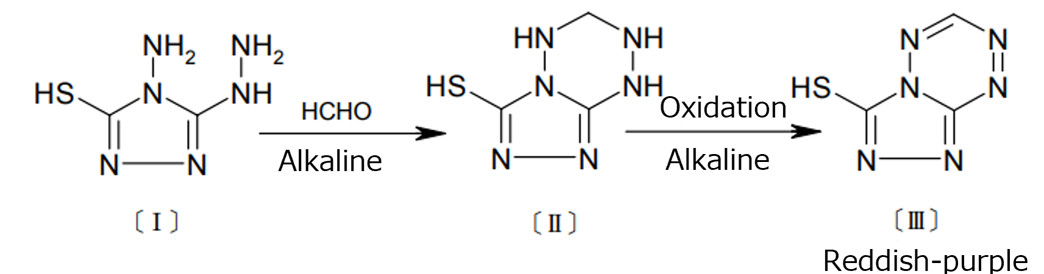
Under alkaline conditions, 4-Amino-3-hydrazino-5-mercapto-1,2,4-triazole [I] condenses with formaldehyde to form intermediate [II]. Intermediate [II] is oxidized to form reddish-purple [1,2,4]Triazolo[4,3-b][1,2,4,5]tetrazine-3(2H)-thiol [III], which has an absorption maximum at 550 nm. The amount of formaldehyde can be determined by measuring the absorbance of the reaction solution at 550 nm.
Features
- Simply add the reagent solutions in sequence to measure formaldehyde in about 30 minutes.
- High sensitivity. Formaldehyde concentrations of 0.1 ppm or higher can be measured, offering approximately three times the sensitivity of the acetylacetone method.
- Because the kit reacts specifically with formaldehyde, the presence of ketones, esters, alcohols, or nitrogen compounds at concentrations of up to about 1,000 ppm has virtually no effect on measurement.
- The developed color is stable, and absorbance shows no significant change for up to 2 hours after color development.
- Day-to-day variation is minimal, providing highly reproducible results.
Measurement Procedure
Kit Contents
| Item | Contents | Volume | Quantity |
|---|---|---|---|
| Alkaline Reagent | 5 mol/L Potassium Hydroxide solution | 200 mL | 1 bottle |
| Chromogen Reagent | 4-Amino-3-hydrazino-5-mercapto-1,2,4-triazole solution | 200 mL | 1 bottle |
| Oxidizing Reagent | Potassium Periodate solution | 200 mL | 1 bottle |
Equipment
- Test tubes
- 2.0 mL graduated pipette
- Spectrophotometer, or photoelectric colorimeter equipped with a 530–550 nm filter
Preparation of Test Waters for Formaldehyde Measurement
- (A) Plywood Furniture
- Refer to JIS A 1460, Determination of the emission of formaldehyde from building boards-Desiccator method.
- Preparation of Test Specimens
Prepare test specimens measuring 150 mm × 50 mm from each plywood sample. The number of specimens shall be such that the total surface area, including the edge surfaces and both faces, is as close as possible to 1,800 cm2. Prepare two sets of specimens. For information on cutting test specimens, refer to Clause 4 (Sampling, Packaging, and Storage) and Clause 5 (Preparation of Test Specimens) of JIS A 1902-1. - Absorption of Formaldehyde into Water
Place a crystallizing dish (outside diameter: 120 mm, depth: 60 mm) containing 300 mL of water at the bottom of a desiccator with an internal diameter of 240 mm (JIS R 3503, Glass apparatus for chemical analysis). Position the test specimens above the dish and allow them to stand for 24 hours to permit formaldehyde to be absorbed into the water. Use the resulting solution as the test water and proceed according to the Measurement Procedure described below.
- (B) Clothing
- Refer to JIS L 1041, Test methods for resin finished textiles.
Method A (For Infant Products)
This method applies to textile products intended for infants up to 24 months of age. Cut the sample into small pieces and weigh 2.50 g into a 200 mL stoppered flask. Add 100 mL of accurately measured water, stopper the flask, and shake to thoroughly wet the sample. Extract for 1 hour at 40°C in a water bath with occasional shaking. While still warm, filter the extract through a glass filter (JIS R 3503, filter plate, porosity code 2) and use the filtrate as the test water. Proceed according to the Measurement Procedure described below.
Method B (For General Products)
This method applies to textile products other than those intended for infants, such as underwear, nightwear, gloves, and socks. Cut the sample into small pieces, weigh approximately 1 g, and accurately determine its weight to two decimal places. Transfer the sample to a 200 mL stoppered flask, add 100 mL of accurately measured water, stopper the flask, and shake to thoroughly wet the sample. Extract for 1 hour at 40°C in a water bath with occasional shaking. While still warm, filter the extract through a glass filter (JIS R 3503, filter plate, porosity code 2) and use the filtrate as the test water. Proceed according to the Measurement Procedure described below.
- (C) Tableware and Similar Articles (Synthetic Resin Products)
- Refer to the Migration Test described in Japanese Specifications and Standards for Food, Food Additives, etc., Part III: General Test Methods for Apparatus, Containers and Packaging, 15. Method for Preparing Test Solutions for Dissolution Testing.
After thoroughly washing the sample, prepare the test water using water heated to 60°C at a ratio of 2 mL per 1 cm² of sample surface area. Maintain the sample at 60°C for 30 minutes, and use the resulting solution as the test water.
Procedure
|
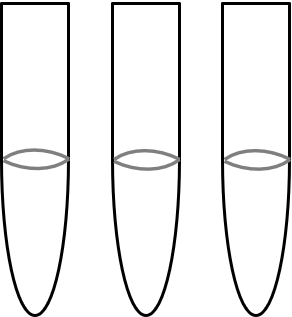
(1) Pipette 2.0 mL each of the test water, standard solution, and distilled water (blank) into separate test tubes. |
(2) Add 2.0 mL of alkaline reagent to each test tube. |
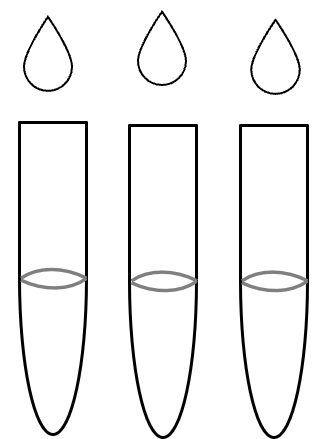
(3) Add 2.0 mL of the chromogen reagent to each test tube and mix thoroughly. |
 |
 |
 |
|
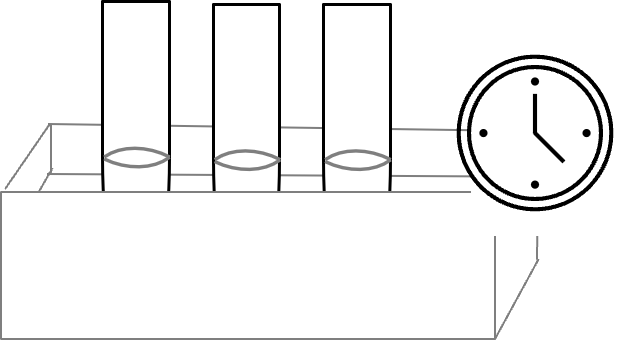
(4) Let the mixtures stand at 20–35°C for 15 minutes. |
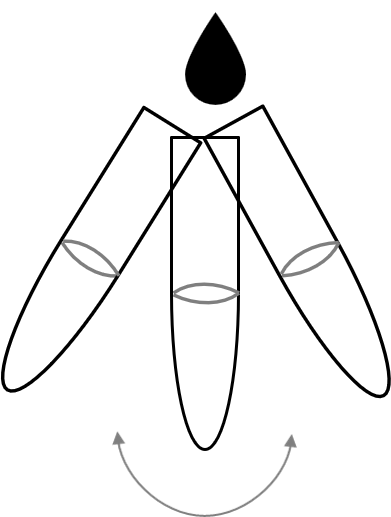
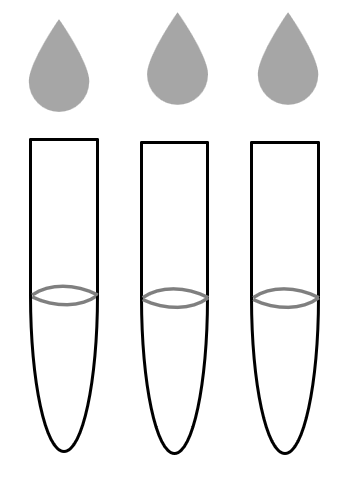
(5) Add 2.0 mL of the oxidizing reagent to each test tube. |
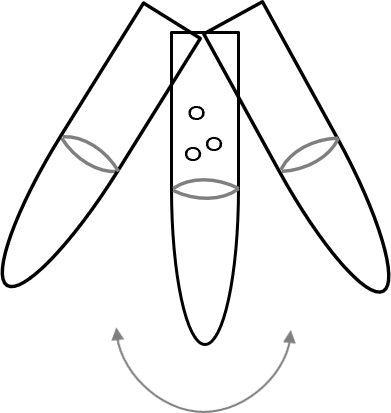
(6) Shake each test tube until foaming stops (about 15 seconds). |
 |
 |
 |
|
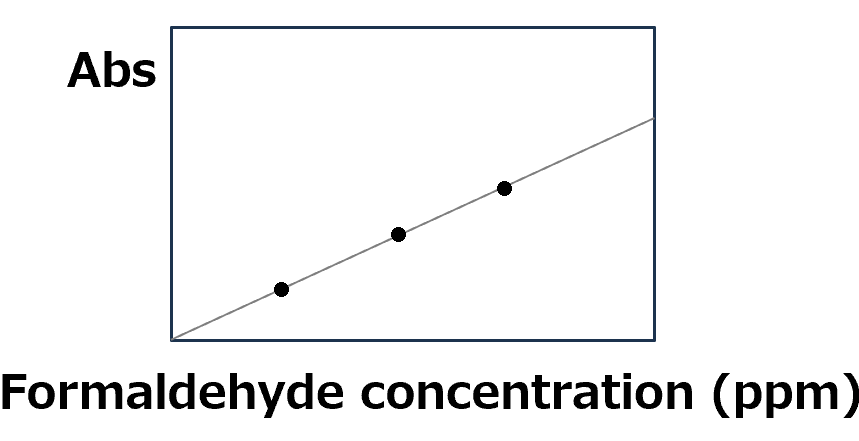
(7) Measure the absorbance of the test water and standard solution using the blank as a control. Determine the formaldehyde concentration from the calibration curve prepared using the standard solution. |
||
 |
||
See below for preparation of the standard solutions.
Formaldehyde Standard Solution
| Code No. | Product name | Grade | Package size |
|---|---|---|---|
| 066-06561 | Formaldehyde Standard Solution (Methanol Solution) | JCSS | 2 mL × 5 A |
Preparation of Standard Solutions
(Example)
| Standard solution | Preparation overview |
|---|---|
| 1 ppm | Formaldehyde Standard Solution 1 mL + water (to 1,000 mL) |
| 2 ppm | Formaldehyde Standard Solution 1 mL + water (to 500 mL) |
- Preparation of a 1 ppm standard solution
Accurately transfer 1 mL of the Formaldehyde Standard Solution into a 1,000 mL volumetric flask using a graduated pipette and dilute to the mark with distilled water. Mix and use for measurement. - Preparation of a 2 ppm standard solution
Accurately transfer 1 mL of the Formaldehyde Standard Solution into a 500 mL volumetric flask using a graduated pipette and dilute to the mark with distilled water. Mix and use for measurement.
Preparation of the Calibration Curve
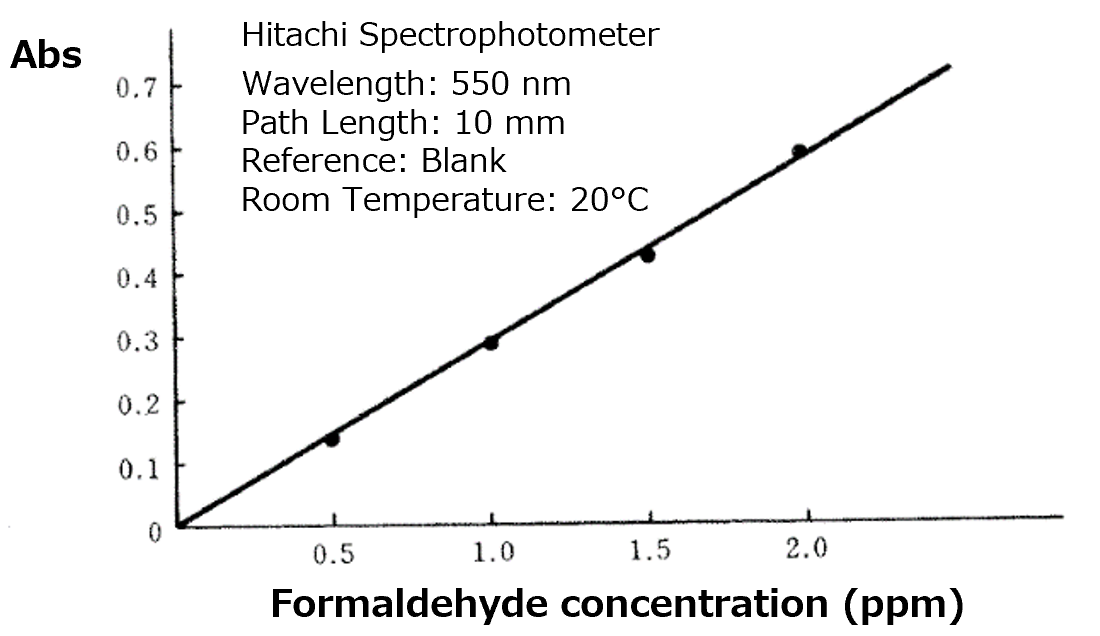
Develop the color of each standard solution according to the measurement procedure described above and measure the absorbance (Abs). Plot Abs on the vertical axis against the formaldehyde concentrations of the standard solutions on the horizontal axis to prepare the calibration curve.
Precautions for Use
- Maintain the standing temperature at 20–35°C after adding the color-developing solution.
- Do not leave any reagent solution open for an extended period. Recap tightly immediately after use and store properly.
- In the presence of aldehydes other than formaldehyde, there is no effect at low concentrations (up to 5 ppm), but color development occurs at high concentrations.
- Because the reagent solutions are alkaline, rinse thoroughly with water immediately if they come into contact with the skin.
Reference Information
1.Effects of Coexisting Substances
(1-1) Aldehydes other than Formaldehyde*
| Aldehyde | Concentration (ppm) |
Absorbance (Abs) λ=550 nm |
Color |
|---|---|---|---|
| Formaldehyde | 5 | 1.40 | Deep reddish-purple |
| Acetaldehyde Propionaldehyde n-Butyraldehyde Acrolein Crotonaldehyde Glyoxal Benzaldehyde |
5 5 5 5 5 100 100 |
0.03 0.02 0.02 0.02 0.02 0.02 0.02 |
Pale yellow Pale yellow Pale yellow Pale yellow Pale yellow Pale yellow Pale yellow |
(1-2) Coexisting substances other than aldehydes*
| Ketones | Esters | Alcohols | Nitrogen compounds | Others |
|---|---|---|---|---|
| Acetone 2-Butanone 4-Methyl-2-pentanone Acetylacetone Cyclohexanone |
Methyl Formate n-Butyl Acetate Triacetin Methyl Methacrylate Dimethyl Phthalate |
Methanol Ethanol n-Propanol Isopropanol Benzyl Alcohol Ethylene Glycol Glycerol Polyethylene Glycol 200 Polyethylene Glycol 2000 |
Ammonia Ethylamine 2-Aminoethanol Pyridine Quinoline α-Naphthylamine N,N-Dimethylformamide Hydroxylammonium Chloride tert-Butylamine |
Formic Acid Acetic Acid Dimethyl Sulfoxide |
* Water-insoluble substances were dissolved and diluted with ethanol.
Solutions containing 1,000 ppm of each substance listed above were prepared, color-developed by this method, and measured with a spectrophotometer (550 nm) or photoelectric colorimeter (530–550 nm).
1. The Abs of each developed solution was 0.02 or less.
2. The color ranged from extremely pale yellow to pale brown.
2.Comparison with Other Methods
(2-1) Clothing (comparison with the phloroglucinol method in Annex JB of JIS L 1041)
| Sample | Fiber composition |
Free formaldehyde (ppm)* | |
|---|---|---|---|
| Formaldehyde-Test wako | Phloroglucinol method |
||
| Trousers | Polyester, cotton | 450 | 440 |
| Curtain | Cotton, rayon | 280 | 270 |
| Curtain | Rayon | 1,450 | 1,570 |
| Shirt | Cotton | 40 | 50 |
| Blouse | Polyester, linen | 60 | 60 |
| Lace fabric | Cotton | 30 | Not detected |
* Values are expressed as the amount of formaldehyde eluted per 1 g of sample.
Preparation of the test water
Cut the sample into small pieces, accurately weigh about 1 g, and place it in a stoppered flask. Add 100 mL of water containing 0.01% nonionic surfactant and extract for 1 hour at 25°C with occasional stirring. Filter through a glass filter (JIS R 3503, filter plate, porosity code 2) and use 50 mL of the filtrate as the test water.
(2-2) Plywood and tableware (comparison with the acetylacetone method)
| Sample | Resin component | Formaldehyde (ppm)* | |
|---|---|---|---|
| Formaldehyde-Test wako | Acetylacetone method |
||
| Plywood | Melamine | 1.5 | 1.5 |
| Plywood | Melamine | 2.7 | 2.6 |
| Plywood | Melamine | 3.2 | 3.2 |
| Plywood | Melamine | 4.6 | 4.7 |
| Chopsticks | Melamine | 0.4 | 0.4 |
| Rice bowl | Melamine | 1.3 | 1.3 |
| Plate | Melamine | 2.2 | 2.1 |
* For plywood, the values are expressed as the formaldehyde concentration in the test water. For food containers, the values are expressed as the formaldehyde concentration in the test water (distillate).
Preparation of the plywood test water
Prepare ten test specimens measuring 150 mm × 50 mm from each plywood sample. Place a crystallizing dish (diameter: 120 mm; height: 60 mm) containing 300 mL of water at the bottom of a desiccator with an internal diameter of 240 mm (JIS R 3503, Glass apparatus for chemical analysis). Place the ten specimens secured in a fixture above the dish and leave at 20–25℃ for 24 hours to allow the water to absorb formaldehyde. Use the resulting solution as the test water.
Preparation of the tableware test water
Wash the sample thoroughly with water and use water as the extraction solution. For samples that can be filled with liquid, fill with extraction solution heated to 60℃, cover with a watch glass, and leave for 30 minutes at 60℃ with occasional stirring.
For samples that cannot be filled with liquid, use extraction solution heated to 60℃ at a ratio of 2 mL per 1 cm2 of surface area. Immerse the sample, cover with a watch glass, and leave for 30 minutes at 60℃ with occasional stirring. Take 10 mL of this solution and add 1 mL of 20% Phosphoric Acid. Place 5–10 mL of water in a 200 mL graduated cylinder and perform steam distillation with the condenser adaptor immersed in the water. Stop when approximately 190 mL of distillate has been collected, then dilute to 200 mL with water. Use this as the test water.
Formaldehyde Measurement Targets and Japanese Regulatory Values (Reference)*
| Target | Regulatory value or criterion |
Measurement method overview |
Reference (Japanese) |
|---|---|---|---|
| Textile products for infants (24 months of age or younger) |
Absorbance difference: 0.05 or less, or 16 μg/g (16 ppm) or less |
Acetylacetone method (JIS L 1041) |
Overview of the Criteria for Regulating Household Products Containing Harmful Substances |
| Underwear, nightwear, gloves, socks, etc. (excluding products for infants) |
75 μg/g (75 ppm) or less | Acetylacetone method (JIS L 1041) |
Overview of the Criteria for Regulating Household Products Containing Harmful Substances |
| Tableware, containers, and packaging (melamine resin, urea resin, etc.) |
Complies with the test requirements |
Acetylacetone method (Specifications and Standards for Food, Food Additives, etc., Part III: General Test Methods for Apparatus, Containers and Packaging) |
Food Sanitation Act (Specifications and Standards for Food, Food Additives, etc.) |
| Indoor air | 100 μg/m3 (0.08 ppm) or less | DNPH-HPLC method (Manual for Measurement of Chemical Substances in Indoor Air (in Japanese)) |
Guideline Values for Indoor Concentrations of Chemical Substances |
* As of November 2, 2026.
Overview / Applications
| Outline | Formaldehyde-Test Wako is a quantitative determination kit to determine the quantity of formaldehyde, utilizing the nature that 4-amino-3-hydrazino-5-mercapto-1,2,4-triazole reacts with formaldehyde under alkaline conditions and produces red-purple color, which is followed by colorimetry. The kit is supplied with reagents but with no standard solutions; therefore, a standard solution should be prepared before use, using formalin of known content. |
|---|
Property
Manufacturer Information
Alias
- Formaldehyde-Test wako
For research use or further manufacturing use only. Not for use in diagnostic procedures.
Product content may differ from the actual image due to minor specification changes etc.
If the revision of product standards and packaging standards has been made, there is a case where the actual product specifications and images are different.
The prices are list prices in Japan.Please contact your local distributor for your retail price in your region.